

Preserving the residues of tradition
Recently I was in a conversation with a mother of two teens and she shared that many people her age (including herself) suffer from "church trauma". She went on to say that she grew up in a church that she has since left because she has been deeply wounded by the church community's stance on particular issues and teachings. While she identifies as Christian she does not attend a place of worship consistently. Finally, when she shared that much of what she is looking for is a worship place that does not have any of the looks/sounds/feelings of the place that caused trauma in her young life. I can only imagine that must be very difficult to do.
I understand there is a desire in some to disassociate with any place of worship that looks like the place that abused them in the past. My heart and prayers go up to them and I am so very sorry that anyone has been abused at the hands of church leadership. I am sure that I too would hesitate to connect with a place that looked like a painful past. What I would like to offer up in this post is not at all speaking to this group of people. I would like to offer up something to the group of people who feel like there are traditions in the church that are passe and should be done away with.
Specifically, there are movements among churches to do away with things like passing the plate for an offering, eradicate silence, avoid talking about anything sad or depressing, eliminate theological language, avoid anything that is too "churchy", etc. The efforts come out of a desire to ensure than no one feels uncomfortable and that people leave feeling good so they will come back.

The eradication of tradition is something that has been going on since the dawn of time and perhaps today is no different than yesterdays. What I would like to submit though is the eradication of tradition is not very creative. It is easy to stop doing something or to do something completely different. What is much more difficult is finding ways to honor and evolve the tradition.
This is what I think Jesus was talking about when he said that he did not come to abolish the law but to fulfill it. He was not one that wiped tradition away, but preserved the residues of tradition for future generations. It has been said that tradition is the voice of the dead and if/when we eradicate tradition those voices die a second time. Tradition is that way to respect the ones who came before us and who worked hard in hopes that this day would arrive.
Cleaning church of tradition might sound great these days in order to "streamline" and be "efficient" and frankly it is easy to do this. The call of the Christian is, in part, a call to honor the entire body of Christ and use the spark of divine creativity to evolve the tradition so that it is fresh and meaningful for today. Preserving the reside of tradition is difficult work, but most important work is difficult.
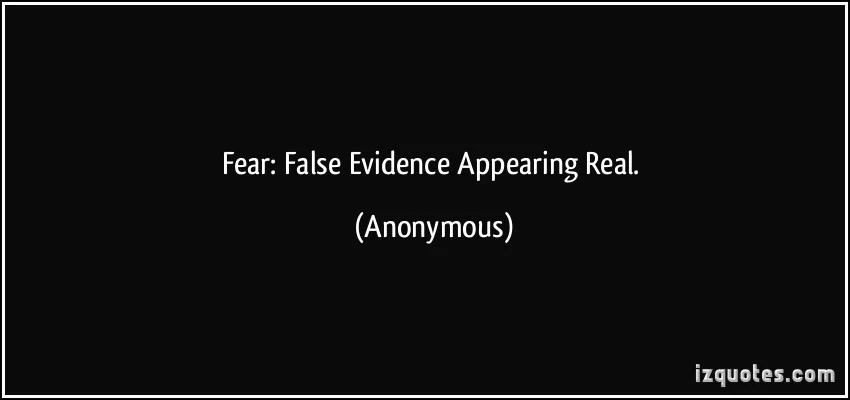
Did You Know Fear is an Acronym?
Rev. Rudy Rasmus shared that fear is what is at the core of the problem in the Church. This is not news to many of us. What was helpful to me, and perhaps to you as well, was a reminder that fear really might be seen as - False Evidence Appearing Real.
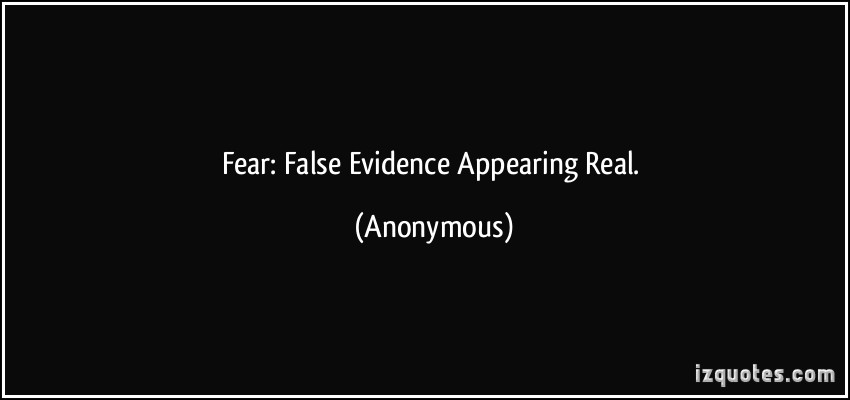
Who knew FEAR could be an acronym?* Maybe it is well know, but it is new to me.
What is the false evidence appearing real in your life? The Church seems to see the rapid of church attendance as equating to the death of Christianity. I would say this is FEAR. Christianity lives as long as Christ lives.
Some see the natural disasters and the rumors of war and the violence as proof that the world is going to hell. I would say this is FEAR. The world has always been headed toward a marriage with the heavens.
* I also am very aware that there is the other definition of fear that is emotion based. When I see a wall of water coming toward me to drown me the fear I feel is not false evidence appearing to be real. It is a real wave. Perhaps this is what makes fear so difficult of an emotion to deal with. It is difficult to see what is real and what is posing as real.

Spinning Around in Order to be Still
Last week I heard Erin Hawkins (The General Secretary of the General Commission of Race Relations for the UMC) speak. One of the things she shared was her time learning a prayer practice of "turning". The Sufi prayer practice of turning (you may have seen "Whirling Dervishes") is deeply symbolic and there is a lot going on in the practice.
The one thing she pointed out was the practice is to be an example how to be "fixed and focused" in a world that is constantly spinning.
It is a beautiful metaphor and one that is often missing or overlooked in Christian churches. How do you practice being fixed and focused on God in Christ through the Spirit while the world spends all around? It is easy to be focused and fixed on retreat or on Sunday morning but what about in the stress and turmoil of the most chaotic spinning?

Be the change by Jason Valendy is licensed under a Creative Commons Attribution-NonCommercial-ShareAlike 3.0 Unported License.