

Remeber: Broken bread means no more broken bodies

At the gathering of the disciples Jesus said that the bread was no longer just bread but it was like his body broken for all. Likewise the cup of wine was like his blood poured out for the forgiveness of sin. And to this day Christians have been breaking bread and pouring wine in remembrance of Christ.
Sometimes we Christians don't know what we are supposed to remember. There are many things that Jesus did and who he was. There is the great sacrifice that he made and that is where I wanted to call attention.
It is not enough to remember the sacrifice of Christ. Remembering is not an act of just pondering or recalling. If we don't allow our remembering of the past to impact our present and thus changes our future, then we are just recalling. We are not remembering.
When Jesus says that his body is broken for sin, that means that no other bodies need to be broken for sin. And his blood is poured out for reconciliation of the world that means no other blood needs to be spilled to "make things right".
When we remember this, the world is transformed. When we recall this, the world is unchanged.

WWJD is the wrong question
When I was a kid I was given a WWJD bracelet. In case you missed this trend, WWJD stood for "What Would Jesus Do?" It was a way to get people to stop and think about what is the action we ought to do - that is what would Jesus do - in a situation. For me it functioned more as a fashion accessory than a Jesus reminder.
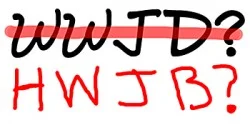
After I wrote this post, I came across writings from another author. I guess I a not original.
As I have gotten older it is much harder for me to answer the question WWJD. Frankly I have little idea what Jesus would do in many current situations. Maybe I am the only one, but I have a difficult time imagine what Jesus did much less what he would do. I know how Jesus would respond to the question, "Who is my neighbor?" but only because I have read the story of the Good Samaritan. I am not sure that I would have guessed that if Jesus was asked that question he would have responded by making up a story.
This leads to the overall problem with WWJD: it leads on to believe that Christianity is primarily a religion of doing things when in fact it is not. Christianity is a religion that is not about doing but about being. And this is where I turn to the desert monastics to help make the point.
In the introduction of James O. Hannay's book "Wisdom of the Desert", he has this to say about what the desert monastics thought about Christianity's relationship with doing good for others.
"The hermits were called selfish because they aimed at being good and not being useful. The charge derives its real force from the fact that philanthropy, that is, usefulness to humanity, is our chief conception of what religion is. We appeal to the fact that Christ went about doing good, and we hold that true imitation of Him consists in doing as He did rather than in being as He was. The hermits thought differently. Philanthropy was, in their view, an incidental result, as it were, a by-product of the religious spirit."
WWJD puts philanthropy front and center to the Christian life, but the desert monastics saw philanthropy as a by-product! That is when we try to answer WWJD we are always going to miss the mark. We have no idea what Jesus would do. However, if we stopped trying to guess what Christ would do and spend our energies being as Christ was then we gain a clarity of how to act in the world.
Jesus prayed in the garden to not die. He would not have chosen to die via the cross. Rather, he stepped away from what to do and sought from God how to be. When he was grounded on how to be, what to do was clear. It was not easy, but it was clear.

My echo is much better than yours
Not long ago my family went to a place where you could yell and hear the echos very well. It was a beautiful place and it was also a place where I saw in my children something that exposed a dark side of myself. The love of my own voice. As we stood there taking turns yelling into the canyon, it did not take long until my kids were each yelling over one another in order to hear their echo. They each wanted the other one to shut up so that they could hear only their voice. A fight broke out and I am sure that everyone around that canyon heard the echos of two children yelling at each other while two parents were yelling at them to be quite. We are the best parents.
A. W. Tozer said, "The world is waiting to hear an authentic voice, a voice from God—not an echo of what others are doing and saying, but an authentic voice." I want to believe this is true, however when I sit in contemplation and prayer I come to doubt that we desire for an authentic voice. In fact, the more I listen to the world around me and even my inner prayer life, it is more and more evident that I seek out the echo more than the authentic voice.
And like my children at the canyon, I tend to find greater satisfaction with the sounds that are echos of my own thoughts, feelings and beliefs. Not only that, but I also tend to think that others will find the sound of my voice much better than they will find the sound of their voice. I tend to come back to the sources that I have already agreed with than to seek out a voice that is different and (dare I say it) may be closer to the desire of God?
This is where I find politics interesting. Specifically when we say that we want a politician that represents us and our voice. We want echos in the chamber not authentic voices. When we say that a candidate "gets us" or "says what no one else will say" we may affirming an echo of ourselves.
And so, if we wonder why there is anxiety and fear in the political process it is not because of the candidates. More often than not, they echo back the voice of their base. We desire the sound of our own voice coming to us at different pitches and volumes, but in the end it is still our voice.
This is where I believe, the Church is helpful. The Church can be a place where we listen for the voice of Christ. Can we stop yelling long enough to let our own echo fade so we may hear the voice of Christ?


Be the change by Jason Valendy is licensed under a Creative Commons Attribution-NonCommercial-ShareAlike 3.0 Unported License.