
Are we Christians really monotheistic? Part 2
The previous post just briefly pointed out that when one thinks there are other gods in the world then monotheism is called into question. Additionally, it was pointed out, that many of us live as though we do think there are other gods in the world (such as the god of pride or the god the money), and as such perhaps many of us Christians operate not out of montheism but out of henotheism or monolatry.
When we orient our lives around the idea that there are other gods in the world, then we can quickly judge these different gods as either good or bad.
 The god of love - good.
The god of hate - bad.
The god of pride - bad.
The god of peace - good.
Once we have judged for ourselves that which is good and that which is bad, we then desire to live our lives out of desiring the good while avoiding the bad.
The little hiccup in our plan however is that as a Christian we understand that God made all things and called them good. So how then can we go though life calling bad what God called good?
Even Jesus did not like being called good when he was identified as a "good teacher".
When we go through life judging for ourselves what is good and what is bad we can find ourselves building a bubble around our lives, insulating us from reality.
We begin to see some people as good and others as bad. We begin to see some ideas as good and some as bad.
When we create a good/bad world (dualism) then we can find ourselves no longer able or willing to help transform the world.
Why would I want to hang out with the "bad" people or read about the "bad" ideas or practice "bad" habits?
When we live in a world which we proclaim good and bad on things which God has called Good, then we live in a world which is not oriented toward monotheism.
The next post if the final of this installment and will (hopefully) be the answer to the question, "so what?"
When we orient our lives around the idea that there are other gods in the world, then we can quickly judge these different gods as either good or bad.
The god of hate - bad.
The god of pride - bad.
The god of peace - good.
Once we have judged for ourselves that which is good and that which is bad, we then desire to live our lives out of desiring the good while avoiding the bad.
The little hiccup in our plan however is that as a Christian we understand that God made all things and called them good. So how then can we go though life calling bad what God called good?
Even Jesus did not like being called good when he was identified as a "good teacher".
When we go through life judging for ourselves what is good and what is bad we can find ourselves building a bubble around our lives, insulating us from reality.
We begin to see some people as good and others as bad. We begin to see some ideas as good and some as bad.
When we create a good/bad world (dualism) then we can find ourselves no longer able or willing to help transform the world.
Why would I want to hang out with the "bad" people or read about the "bad" ideas or practice "bad" habits?
When we live in a world which we proclaim good and bad on things which God has called Good, then we live in a world which is not oriented toward monotheism.
The next post if the final of this installment and will (hopefully) be the answer to the question, "so what?"
Are we Christians really monotheistic? Part 1
There are a number of debates to this question. Some say yes because of the "one God" thing while others point to the Trinity as less monotheistic and more polytheistic.
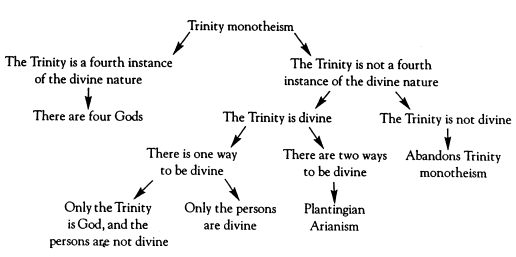 Frankly I do not really care about that too much. I will leave that debate to others who are more philosophical and smarter than me to hash out. (see the elaborate chart to the right for more confusion on the "is the trinity really monotheism" debate. It just blew your mind.)
Rather this is the first post in regards to the Exodus 32, in which Aaron makes for the people a golden calf which they go on to ascribe deity status to and worship it. This is the original "idol" in the Biblical narrative and the one that gets the most play when we talk about idolatry.
Most of the time, we Christians act like there is one God. Most Christians that I know, do not speak of multiple gods running around in the heavens above us as in Greek mythology. And yet, many nominally Christian people I encounter do not orient their lives around monotheism - the belief in one and only one God.
Many Christians orient their lives around the idea that there is one God (the God of/in Christ Jesus) but also do not deny there are other gods or other powers in the world that are god-like. To take a simple example, many Christians talk about dealing with the temptation of the 'god of wealth' or the 'god of pride'. On a lighter note, football fans speak of the 'football gods' when their team cannot catch a break.

Silly as it sounds, many Christians speak as though these 'gods' do exist on some level - even a metaphorical one. And when we do not personally deny the existence of a god but choose to worship one God in particular then we are not really orientated to monotheism. Rather we are talking about either henotheism or monoaltry.
Henotheism is the idea that other gods exist, and they in fact may be worthy of praise, but one chooses to worship a particular God.
Monoaltry is the idea that other gods exist, and they are not worthy of praise, and so one chooses to worship a God that is worthy of praise.
Hold those thoughts, the next post will explore how henotheism and monoaltry directly affect how we move and interact with the world.
Frankly I do not really care about that too much. I will leave that debate to others who are more philosophical and smarter than me to hash out. (see the elaborate chart to the right for more confusion on the "is the trinity really monotheism" debate. It just blew your mind.)Rather this is the first post in regards to the Exodus 32, in which Aaron makes for the people a golden calf which they go on to ascribe deity status to and worship it. This is the original "idol" in the Biblical narrative and the one that gets the most play when we talk about idolatry.
Most of the time, we Christians act like there is one God. Most Christians that I know, do not speak of multiple gods running around in the heavens above us as in Greek mythology. And yet, many nominally Christian people I encounter do not orient their lives around monotheism - the belief in one and only one God.
Many Christians orient their lives around the idea that there is one God (the God of/in Christ Jesus) but also do not deny there are other gods or other powers in the world that are god-like. To take a simple example, many Christians talk about dealing with the temptation of the 'god of wealth' or the 'god of pride'. On a lighter note, football fans speak of the 'football gods' when their team cannot catch a break.
Silly as it sounds, many Christians speak as though these 'gods' do exist on some level - even a metaphorical one. And when we do not personally deny the existence of a god but choose to worship one God in particular then we are not really orientated to monotheism. Rather we are talking about either henotheism or monoaltry.
Henotheism is the idea that other gods exist, and they in fact may be worthy of praise, but one chooses to worship a particular God.
Monoaltry is the idea that other gods exist, and they are not worthy of praise, and so one chooses to worship a God that is worthy of praise.
Hold those thoughts, the next post will explore how henotheism and monoaltry directly affect how we move and interact with the world.
How Many Slaves Work for You?
This is another little survey to discover a bit more about the human slavery issue around the world. We might think that since slavery is illegal in the US then Americans must be "slavery free."
Take this little survey (it is easy to do but you can take a long time on this if you want to get more specific/accurate).
My first run at this test shared that I had 25 slaves working for me. :(
As soon as I saw that I instantly thought, "Now wait just a minute. I should go back and modify some of my responses and try to rationalize away some things. For instance this does not take into account that I am actually answering for a family of three people. So I should/could split this number into three and that is much more accurate..."
This sort of rationalizing when on and on in my mind for a while until I realized just how crazy it is to think that I would feel better to have 8 slaves than 25 slaves.
One slave is one slave too many.
Take this little survey (it is easy to do but you can take a long time on this if you want to get more specific/accurate).
My first run at this test shared that I had 25 slaves working for me. :(
As soon as I saw that I instantly thought, "Now wait just a minute. I should go back and modify some of my responses and try to rationalize away some things. For instance this does not take into account that I am actually answering for a family of three people. So I should/could split this number into three and that is much more accurate..."
This sort of rationalizing when on and on in my mind for a while until I realized just how crazy it is to think that I would feel better to have 8 slaves than 25 slaves.
One slave is one slave too many.

Be the change by Jason Valendy is licensed under a Creative Commons Attribution-NonCommercial-ShareAlike 3.0 Unported License.