

We All Have Bought A $120,000 Banana
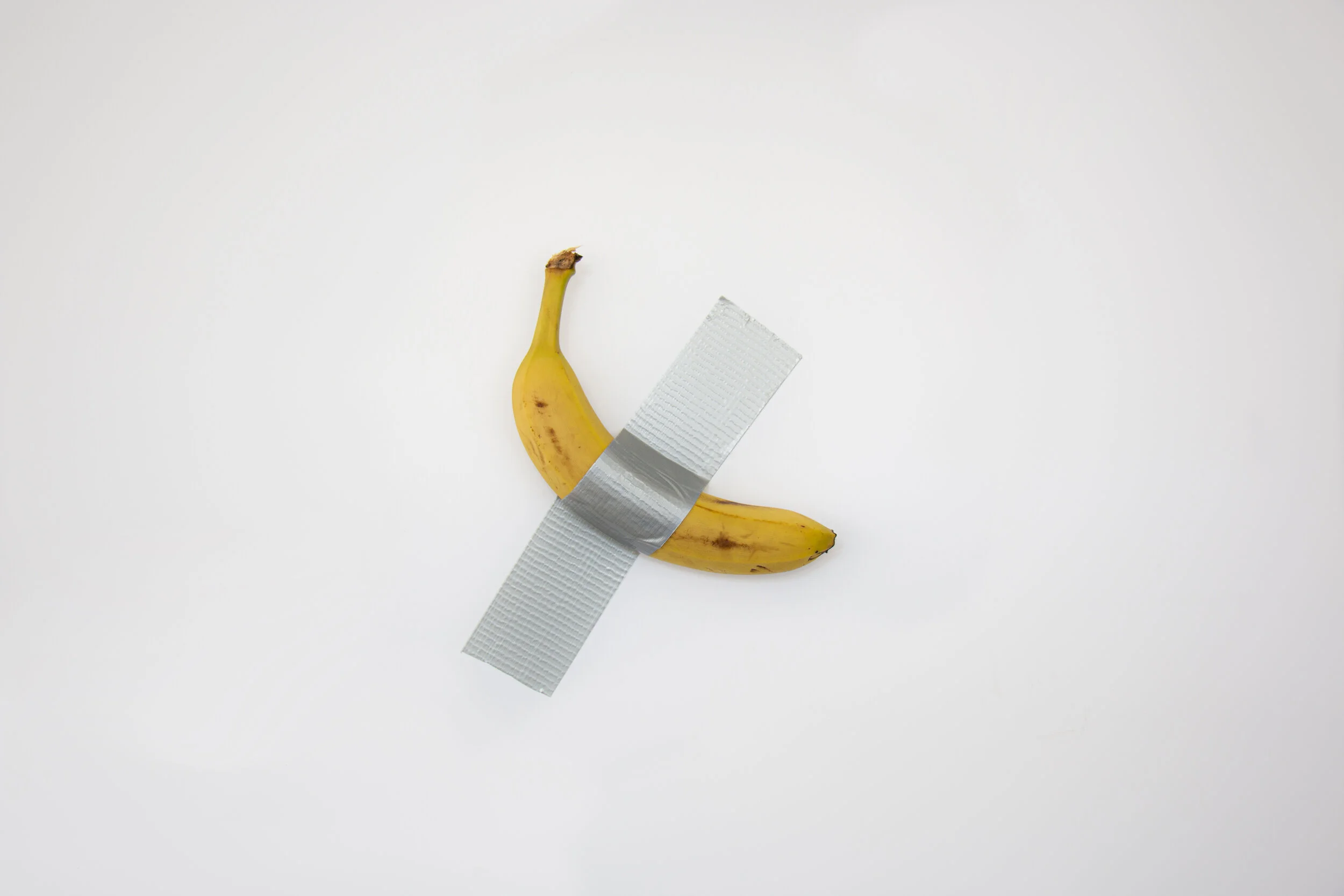
If art is anything, it is provocative. For anyone who has ever looked at a bit of art and thought, “My kindergartner can paint that! Why don’t you give her $120,000 for her play-doe sculpture?” you are not alone.
Recently humanity lost our collective mind over a banana duct taped to a wall that sold for $120,000. There are many memes to thought pieces on this bit of art. Some believe it to be brilliant. Some find it crazy, others find it immoral and still others wonder what sort of world do we have when people cannot pay for their medical bills while others buy a $120,000 banana.
It is an easy target to throw stones at. It sounds insane that anyone would buy this much less anyone else call it art. We wonder what rich person could possibly have such a cold hart to waste money in this way. We wonder why the wealthy are putting more money to art than towards social services, charity or the common good. We see this bit of art as a proxy for all that is wrong with the millionaires and billionaires of the world. Then, when we hear the buyer of this banana ate the banana we just melt into madness!
Beyond how you feel about this specific banana and duct tape, the purchase, or the people involved I want to remind us that we all have bought a $120,000 banana.
We all have spent money on fleeting things (fast fashion?). We all have justified our expenses on things over using our money for the common good (don’t we all need three winter coats?). We all have bought into consumerism and purchased things just because everyone is a twitter about them (fidget spinners anyone?) We all have bought things that others disprove of (you have seen the National Inquire, right?). We all feel justified in our decisions and condemn others’ (I am improving the value of my home with these updates, you are wasting your money on buying a boat.).
We may not have signed a check for the same dollar amount, but we all have bought our version of the $120,000 banana.
No matter how we feel about this banana it reveals to us that we are no better or worse than the one “wasting their money” on a banana. We all feel justified with our own actions. We all feel like others are the problem.
I am thankful that we know the name of the couple who bought the banana. At least they are not hiding behind anonymity and are willing to publicly face the very questions we all should be asking ourselves every day.

Salvation's Default Setting
Default settings influence behavior. According to Behavioraleconomics.com
Requiring people to opt out if they do not wish to donate their organs, for example, has been associated with higher donation rates (Johnson & Goldstein, 2003). Similarly, making contributions to retirement savings accounts has become automatic in some countries, such as the United Kingdom and the United States.
These default settings are more than just organ donation and retirement accounts. Default settings impact our understanding of salvation.
What do you think is salvation's default?
Some of us hold that all of humanity is defaulted to hell or separation from God. The way to change the setting from the default (hell) to a different option (heaven) is by accepting Jesus as Lord and be baptized. The rest of life is working to ensure that the change in the salvation setting sticks and does not return to the default setting. There is a concern that living an unchecked life our salvation setting will return to the default.
Some of us hold that all of humanity is defaulted to heaven or union with God. There is nothing that can separate us from the love of God. There are times when the consequences of our actions change the setting, but God is quick to change the setting back to salvation. The rest of life is living out of thanksgiving for the Good News of God’s saving grace and love.
Salvation’s default setting does not mean that is what salvation will be: not unlike defaulting into being an organ donor means you will be an organ donor. Things change. We live with the consequences of our actions and no one knows for certain what is to come.
Perhaps our approach to “the other” is dependent upon how we see salvation’s default setting? Perhaps our approach to our own lives is dependent upon how we see salvation’s default setting?
And so, what is salvation’s default setting?

Not Wanting to Know that We Know
The brothers came to Antony and said to him, “Tell us: How are we to be saved?” The old man said to them, “You have heard the Scriptures. That should teach you how.” But they said, “We want to hear from you, too, Father.” Then the old man said to them, “The Gospel says: If anyone strikes you on the right cheek, turn the other also” (Matthew 5:39). They said, “We cannot do that.” The old man said, “If you cannot offer the other cheek, at least allow one cheek to be struck.” “We cannot do that, either,” they said. So he said, “If you are not able to do that, do not return evil for evil,” and they said, “We cannot do that, either.” Then the old man said to his disciple, “Prepare a little brew of corn for these invalids. If you cannot do this, or that, what can I do for you? What you need is prayers.”
This translation of this desert story is found in The Wisdom of the Desert Fathers and Mothers, There is a lot going on in this story, however what stands out to me is the line “we want to hear from you, too, Father.” These seekers ask a question but Antony says these seekers know the answer. The seekers seem to pretend they do not like or understand the answer they know from the scriptures, so they ask Antony for an answer.
Antony tells them that they know the answer - it is in the scriptures. He goes on to share with them the things they already know (turn the cheek, forgive, do not repay evil for evil). But they feign an inability to do such things.

The seekers know the answer, but they do not want to know that they know. As long as they can pretend to not know the answer, the longer they can hold out hope that there is some other, more palatable, answer out there.
So Antony says what the seekers really need is prayer. Not prayer for salvation, but prayer that they may come to accept what they already but refuse to know.
This is a function of prayer. Prayer helps us come to terms with what we know but we don’t want to know that we know. It is the tool God gives for us to face the truths we know but pretend to not know, in the hope that there is some other, more palatable, answer out there.
We often know what we seek. We often do not want to know that we know it.
Prayer changes us because it revels to us what we know. We no longer pray for that which we know that we know.
No wonder so many of us resist prayer. We are not unlike the seekers. We do not want to know that we know.

Be the change by Jason Valendy is licensed under a Creative Commons Attribution-NonCommercial-ShareAlike 3.0 Unported License.