
Pentecost as a capstone?
In the opening chapters of Genesis (1-2) we read about Adam and Eve. We then move into a story of temptation (3). The next chapters (4-5) we hear about the first murder and how Abel's blood cried our for vengeance. Genesis 6 has the story of the flood, where there is death for all. Genesis 11 we read of the tower of Babel where language divides the nations.
Could it be that the gospel writer Luke uses this framework to structure his story of salvation?
Luke 3 there is the genealogy of Jesus that goes all the way back to Adam - thus implying Jesus is a new Adam.
Luke 4 there is Jesus' temptation. And where Adam failed Jesus prevailed.
Luke 23 Jesus is murdered, but unlike Abel who cries out to God for revenge, Jesus cries out to God for forgiveness and mercy.
Luke 24 tells the story of the resurrection where the world is not destroyed but is resurrected through the life of Christ.
Finally, where language was the cause of division of the nations in Genesis, in Acts 2 language becomes that which unites the nations.
Here is a chart I made for those who want this in a liner fashion.

Could it be the story of Luke/Acts (in case you are unaware it is believed these were really one story broken into two "books" written by the same author), is also a story of new creation? Not just in a spiritual sense, but in a very real sense, could it be that like Genesis, Luke/Acts tells a creation story.
Could it be that the story of Pentecost is a capstone to a set of stories that count-balance Genesis?
Liturgy as script, communion as dress rehearsal
Some people are not big fans of written liturgy. You know the sort of stuff is said as a group in one voice as everyone reads the same words written on the page. Those who have shared their dislike of written liturgy with me, tell me that having the pastor or the people read something feels not genuine or from the heart. They are just words on the page that don't have any meaning - it is empty.
Now I am not here to say that all written liturgy is great. I have encountered very bad written liturgy (as I have encountered very bad 'words from the heart'). There are times when a written liturgy is more appropriate than others. I can also argue that words themselves are just symbols and meaning is established by people and if you encounter something that is not meaningful, you hold a large part of the responsibility of making meaning.
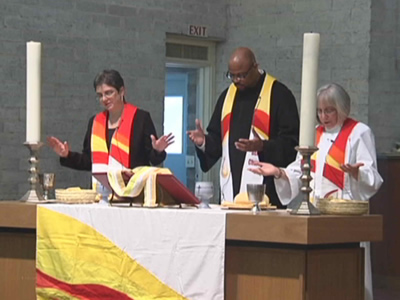
I want to submit that liturgy is much like a script in a play or a movie. In that it is a set of words that are prescribed for a certain situation in order to act out a specific reality. No one who watches a play or movie a dozen times gets angry that the actors are saying the same thing all the time, or that they are just reading words from a page that have no meaning. No, we understand the role of a movie or play - to transport us and show us a picture of something else.
Liturgy is the script we hold to. We have lines that we refer to in worship that are designed to act out a reality in worship so that it would inform our lives outside of worship. When the UMC celebrates communion, we do so with a script (a liturgy) that guides us to recall a specific story. We live out that story time and time again. And we act it out time and time again not for kicks but as a dress rehearsal.
So the next time you find yourself in the middle of the communion liturgy, ask yourself, what are we rehearsing at this moment? For instance, what is the communion liturgy a rehearsal for outside the worship?
Be the Change + Disqus = New way to comment

While most of you who read this site do not comment, that does not mean comments will go away. In fact, I have recently integrated Disqus into this blog.
What does that mean? Taken from the Disqus website:
Works everywhere — No matter what platform you use, Disqus integrates seamlessly.
Why use Disqus? — Disqus drives real engagement and traffic on websites. The fully real-time Disqus is perfect for participation on breaking news, hot discussions, live events, and video content.
Who uses Disqus? — Disqus is used by some of the largest names across the web. Every month, Disqus’ connected platform reaches over 700 million people.
One of the great things about Disqus is that when you comment using Disqus then you are able to log into one place (your disqus dashboard) and see all the comments and those who have replied to your comments in one place.
If you are not a disqus member, you may want to consider doing so - be the change and get involved in the discussions of our time.

Be the change by Jason Valendy is licensed under a Creative Commons Attribution-NonCommercial-ShareAlike 3.0 Unported License.