
Liturgy as script, communion as dress rehearsal
Some people are not big fans of written liturgy. You know the sort of stuff is said as a group in one voice as everyone reads the same words written on the page. Those who have shared their dislike of written liturgy with me, tell me that having the pastor or the people read something feels not genuine or from the heart. They are just words on the page that don't have any meaning - it is empty.
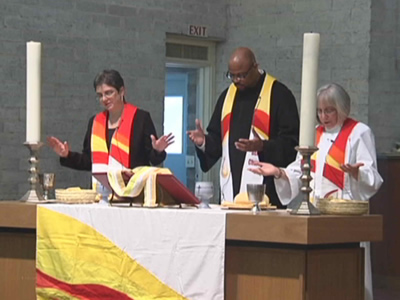
Now I am not here to say that all written liturgy is great. I have encountered very bad written liturgy (as I have encountered very bad 'words from the heart'). There are times when a written liturgy is more appropriate than others. I can also argue that words themselves are just symbols and meaning is established by people and if you encounter something that is not meaningful, you hold a large part of the responsibility of making meaning.
I want to submit that liturgy is much like a script in a play or a movie. In that it is a set of words that are prescribed for a certain situation in order to act out a specific reality. No one who watches a play or movie a dozen times gets angry that the actors are saying the same thing all the time, or that they are just reading words from a page that have no meaning. No, we understand the role of a movie or play - to transport us and show us a picture of something else.
Liturgy is the script we hold to. We have lines that we refer to in worship that are designed to act out a reality in worship so that it would inform our lives outside of worship. When the UMC celebrates communion, we do so with a script (a liturgy) that guides us to recall a specific story. We live out that story time and time again. And we act it out time and time again not for kicks but as a dress rehearsal.
So the next time you find yourself in the middle of the communion liturgy, ask yourself, what are we rehearsing at this moment? For instance, what is the communion liturgy a rehearsal for outside the worship?
Be the Change + Disqus = New way to comment

While most of you who read this site do not comment, that does not mean comments will go away. In fact, I have recently integrated Disqus into this blog.
What does that mean? Taken from the Disqus website:
Works everywhere — No matter what platform you use, Disqus integrates seamlessly.
Why use Disqus? — Disqus drives real engagement and traffic on websites. The fully real-time Disqus is perfect for participation on breaking news, hot discussions, live events, and video content.
Who uses Disqus? — Disqus is used by some of the largest names across the web. Every month, Disqus’ connected platform reaches over 700 million people.
One of the great things about Disqus is that when you comment using Disqus then you are able to log into one place (your disqus dashboard) and see all the comments and those who have replied to your comments in one place.
If you are not a disqus member, you may want to consider doing so - be the change and get involved in the discussions of our time.
We have a mission not a market
Some say, "The Church is a business." I would contest that. The Church is not immune to the cultural influence of the business world. Strategies business protocols are integrated into the Church. Some of this is rather helpful. For instance, good business ethics is good Church ethics. However, the business world influence on the Church is not all great. And perhaps the most difficult influence business has on the Church is that of language.
Businesses look for their market. They do market research and are able to categorize people into groups with somewhat predictable habits. So you get Kellogg buying up TV time during Saturday morning cartoons in order to pitch to their 'market' the greatest cereal known to humankind - Frosted Flakes. Or Facebook will have targeted ads on your profile based upon past clicking patterns.

Businesses look to find their market and respond to their markets demands. You looking for something? Just wait, someone will try to sell you on something. But the amazing thing about businesses is that they are able to create a need that you did not know you had. This is the brilliance of the infomercial. I thought towels were good enough then I saw the ShamWow commercial and now I am not so sure.
Churches are influenced in doing this sort of thing - creating a market. I have seen a number of sermon series that are very infomercial-esk. Generating a problem that I did not know I had, and you would never guess who has the solution? The Church that "showed" me my problem.
Churches are not called to a market but to a mission.
We do not create our mission. We do not do market research to see which neighborhood, who happens to look a lot like us, needs our solutions. We are not set up to pitch a product to a certain type of person based upon past history.
I wonder if we are sacrificing our mission in order to chase our market.

Be the change by Jason Valendy is licensed under a Creative Commons Attribution-NonCommercial-ShareAlike 3.0 Unported License.