
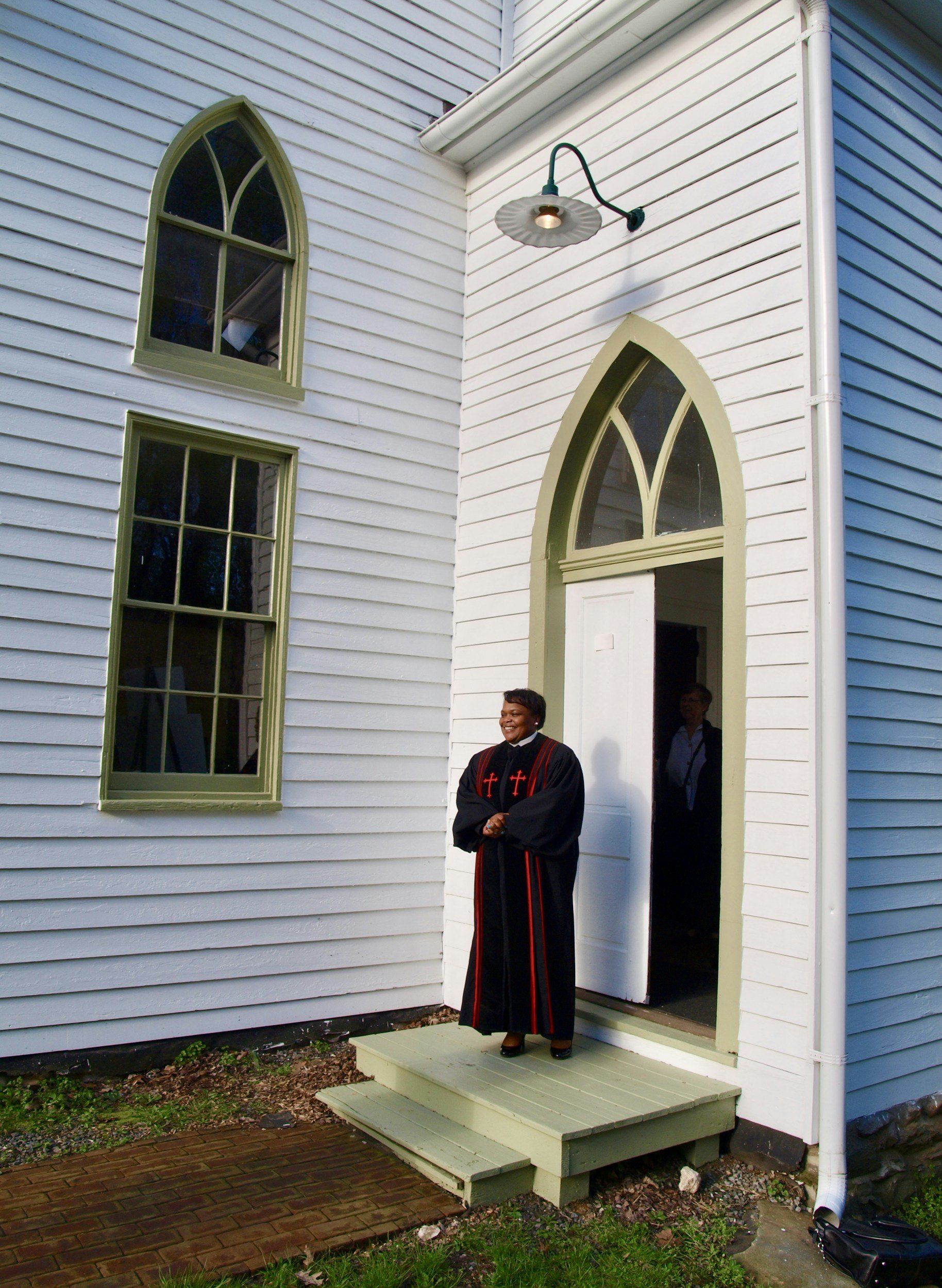
Am I Your Pastor or Your Priest? It Depends Who’s Asking.
Clergy titles—preacher, pastor, minister, and priest—reflect distinct expectations: proclaiming, caring, organizing, and mediating the sacred. Each shapes how congregations understand ministry. My own draw toward the priestly role reveals how unfamiliar titles spark curiosity. What we call clergy forms both their identity and the community’s expectations.
It is not uncommon for clergy to be called different titles. These titles might reflect the tradition the speaker comes from, and that tradition might have a preferred role for a clergy person. The four most common titles I have been given in this way are:
Preacher
Pastor
Minister
Priest
Perhaps used interchangeably, these titles really are four different ways of being a clergy person.
The title preacher places unmistakable emphasis on the act of sermonizing. One of the clearest examples of the expectations woven into this title comes from a greeting I have received more than once: “Hey preacher, what’s the Word for today?” Whether I am standing in a pulpit or waiting in line at the pharmacy, the assumption is the same—the clergy person’s primary role is to preach.
I have walked into hospital rooms and been met with, “What are you doing here, preacher?” This is often said as a way for the patient to acknowledge that their condition may be more serious than they realized, or perhaps to apologize for inconveniencing the clergy person. But it also reveals another assumption: if someone understands the clergy person primarily as a preacher, then it feels strange to see that person in a hospital room. Hospital visits, after all, belong to the domain of the pastor, not the preacher.
The title pastor places the emphasis on care. I never took any courses in “preacher care,” but I took several in “pastoral care.” Because the pastoral identity carries a premium on caregiving, pastors often spend less time refining the art of preaching and more time developing their relational skills. During my internship, a pastor once said to me about preaching, “The congregation doesn’t care what you know until they know that you care.” One of the most iconic pastors I know is a man named Raul. Raul was not a strong preacher and was often late to events, yet he was given endless grace because everyone knew that Pastor Raul’s heart was consistently oriented toward serving others.
If the title pastor emphasizes relationships and individual care, the title minister tends to emphasize relationships and communal care. Ministers often give greater attention to structures, systems, and organizational dynamics because the scope of their responsibilities extends beyond what a single person can accomplish alone. There is likely a reason the words minister and administer share the same root. When I arrive at weddings I’m officiating, the coordinator usually asks, “Are you the minister?” The State recognizes clergy as administrators on its behalf. In addition, ministers are often expected to supervise others or manage systems in ways that preachers and pastors are not. In particular, the minister is presumed to have a stronger role in the temporal management of the church or congregation.
The title priest also emphasizes management, but it is aimed less at managing the temporal realm and more at stewarding the spiritual realm. The role of the priest is that of a mediator between earth and heaven. In many traditions, particularly within Catholicism, priests administer sacraments that are not understood in purely material terms. The sacraments are sacred, imbued with or transformed into something transcendent. In the priest’s hands, bread and wine become the body and blood; water becomes holy water; a simple bedside prayer becomes a rite for the dying; oil becomes Chrism. Of the four titles, priest is the one I have been called the least, yet people have asked me to fulfill priestly functions more times than I can count.
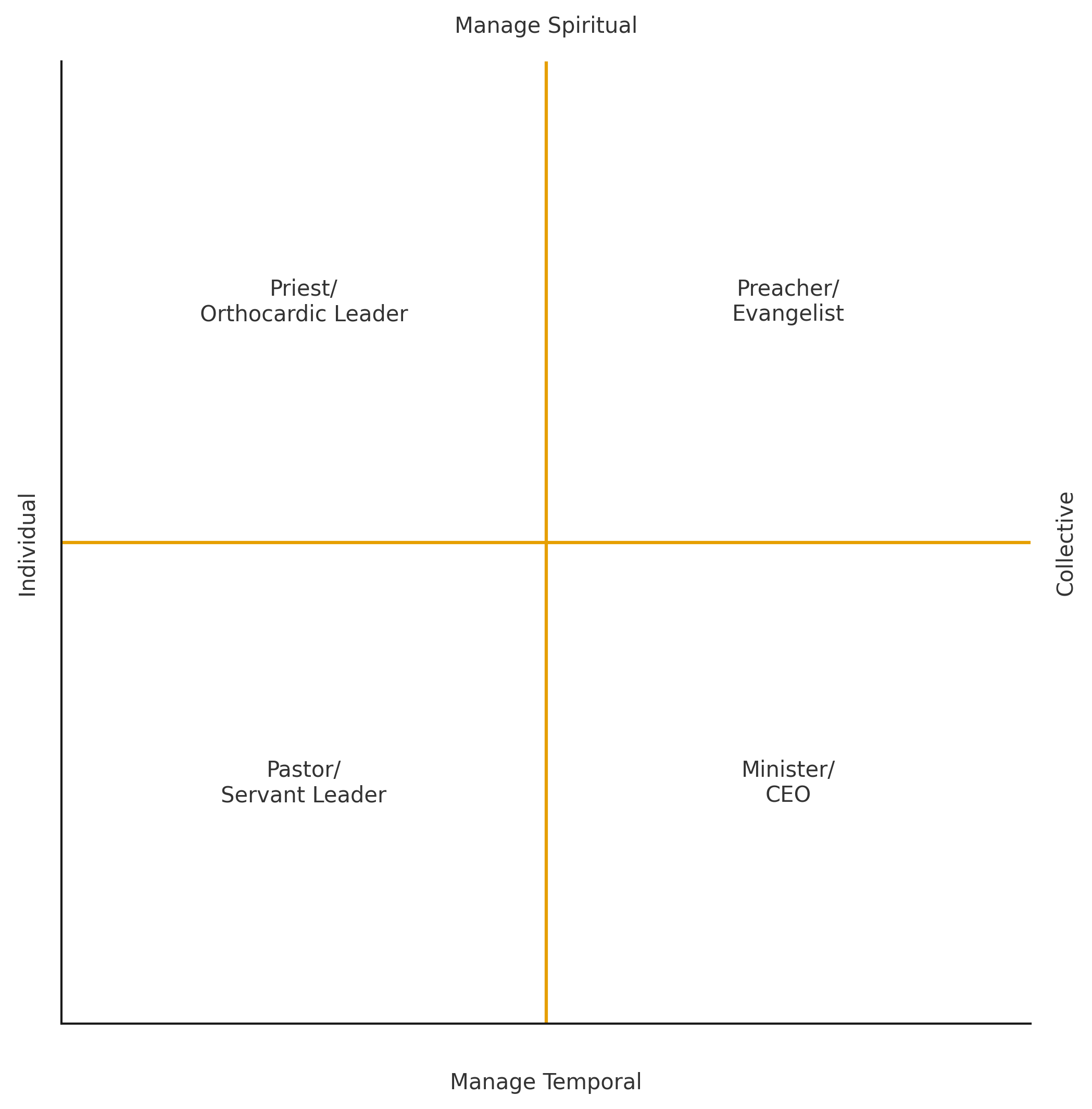
If we were to chart these four roles, we might picture a vertical axis distinguishing different forms of management and a horizontal axis highlighting whether the emphasis is on the individual or the collective. (Readers of Orthocardic Leadership – Pastoral Leadership Inspired by Desert Spirituality will also recognize how the four models—Orthocardic, Evangelist, Servant Leader, and CEO—fit naturally within this same matrix.)
In my local church, every clergy person is called “Pastor _________.” This is not because any of us requested the title—certainly not in my case as “Pastor Jason.” Rather, it reflects an embedded theological assumption within the congregation. In this community, the implicit expectation of clergy becomes explicit the moment someone names us.
Personally, I am drawn toward the role of the priest. Whenever I talk about Orthocardic Leadership in my tradition, the immediate response is usually, “I love the idea—but what does it look like?” My struggle to articulate it is partly a reflection of my own tradition’s limited experience with priests. Yet I have learned something surprising: the more I function in priestly ways, the more people express curiosity about ministry, religion, and Christianity itself.
What role or title do you implicitly associate with clergy? What we call clergy, and what clergy hope to be called, is never just a matter of preference. It is language that shapes both the clergy person and the congregation.

Pastor, I know you are busy...
About every fourth or fifth email I receive and about half of every phone conversation I have, I hear something like, “I know you are busy, but…” I cannot speak for every pastor but I believe that this modified story from the spirituality of the desert story might speak for many clergy - including myself:
There was a student who went to a teacher and asked for a word. The teacher shared a word with the student who went back home. The next day the student forgot what the teacher had said, so the student returned to the teacher.
“I am sorry teacher, but I have forgotten what you said yesterday. Can you share a word with me?”
The teacher spent a little more time with the student this second time, and then the student went back home.

A week later, the student returned and said, “Teacher, I am so sorry to bother you and I have asked now two times, but I have forgotten and would you share a word?”
The teacher sat all day with the student before the student returned home.
After two weeks, the student returned to the teacher. The student felt ashamed and was embarrassed to ask the teacher, yet one more time, “I know you are busy, and I know that I have taken a lot of your time already, but I have forgotten what you said. Could you remind me again?”
At this point the teacher took the table lamp that was to his right and asked the student to pass him a candle that was on the entry table. The teacher lit the candle, handed it to the student, and asked the student for a second candle from the entry table. The teacher lit the second candle, handed it to the student who was asked to retrieve a third and then a fourth candle.
The teacher lifted the lamp up and looed at the student who was now holding four lit candles. The teacher said, “Is the lamp diminished because it gave some of its light to the four candles?”
The student understood and said, “No.”
Never again did the student hesitate to visit the teacher and both of their homes became full of light.

Diagnosed with “Foot in Mouth” Syndrom
One of the things about being a pastor is trying to strike up conversations with people who have varying degrees of expectations of what a pastor is/does. Some people desire that the pastor know a lot about their lives while others have the pastor on a need to know basis. I am still learning to be comfortable with who I am and as such I tend to over-function and want to try to meet others expectations of me rather than focus on what I am called to do/be.
This over-functioning in order to try to meet the expectations of others leads to the diagnoses of “foot in mouth” disease. Perhaps you have this diagnosis as well? Let me share a few of my more memorable afflictions:
- I asked a seminar leader for specific advice before the conference began. When the conference began the first rule that was shared was not to bother the leader with specific advice. The leader looked right at me when the rule was shared.
- I asked if someone got some sun over the weekend, only to be told that the redness is a skin condition.
- I stood on the General Conference floor (the governing body of the entire UMC) and asked a three minute question in order to clarify where we were in the proceedings in the hopes of moving the body forward only to be told after the explanation that all I had to do was say, “I call the question.”
- I said the wrong last name at a wedding.
- I gave looked Joe in the eyes for a year as I said, “The body of Christ broken for you Joe.” Only to be told when he moved that his name is not Joe.
- I welcomed a family to worship and asked their son if he liked superman. The parents shared with me that their nine year old was their daughter.
- I asked a member of AA if they ever wanted to get a drink with me to talk about their life I would open to that.
Perhaps you have your own situations. I share these in order to remind us you that we all mess up in social situations. I have foot in mouth. Sometimes I mess up so bad people leave the church or I just embarrass myself or make it awkward. I wait patiently for a cure for Foot in Mouth, but until then I trust in the Grace of God and God’s people when I step in it.

Be the change by Jason Valendy is licensed under a Creative Commons Attribution-NonCommercial-ShareAlike 3.0 Unported License.