

Privilege Says...
I want to introduce you (in case you do not already know of her work) to Dr. Christena Cleveland. Her website introduces her as:
”a social psychologist, public theologian, author, and activist. She is the founder and director of the recently-launched Center for Justice + Renewal, a non-profit dedicated to helping justice advocates sharpen their understanding of the social realities that maintain injustice while also stimulating the soul’s enormous capacity to resist and transform those realities. Committed to leading both in scholarly settings and in the public square, Christena writes regularly, speaks widely, and consults with organizations.”

Image by David Rochas - used with permission from Dr. Cleveland’s office
You might be interested in exploring her Learning Community where you can get a sense of her current and how to support her future work.
Dr. Cleveland wrote the following poem. From what I understand the insights she elevates are not “new” to those who study and speak about privilege. The poem’s power resides in her ability to list several examples of what privilege looks like. As a person who as more privilege than most people in the world, I am humbled by Dr. Cleveland’s work and give thanks for the ways she is gracefully teaching me. I know that I have so much learning, no, so much unlearning to do. I pray that others in my position will join in the efforts to repent of our blindness and admit that we might very well be doing more harm than we would like to admit. And may our repentance lead not forgiveness and change of how we use our privilege.
I share the following poem with permission from Dr. Cleveland’s office:
Privilege Says...
Privilege says I'll only listen to people who experience oppression if they offer practical solutions to the problems that they describe.
Privilege says learn my language, my customs, and my particularities -- so we can all enjoy unity.
Privilege says the world's problems would be solved if everybody were just like me.
Privilege says I can dress unbecomingly but still be perceived as edgy, unique or not materialistic, rather than homeless.
Privilege says I'll only listen to people who experience oppression if they communicate in a way that's easy for me to understand.
Privilege says I have no cultural identity.
Privilege says diverse people should come to my spiritual community, on my turf, in my comfort zone.
Privilege says I've earned everything I've got.
Privilege says the characteristics of the divine that are most evident in my culture are the most important ones.
Privilege says why are people who experience oppression always talking about oppression? Why can't we all just get along?
Privilege says your perspective is tainted by your culture. I speak pure truth.
Privilege says I'll only listen to people who experience oppression if they describe their negative experiences in a super hopeful way and I leave feeling super hopeful.
Privilege says that reverse discrimination is real.
Privilege says I'll only listen to people who experience oppression if they come to my institution/conference/social space. I don't see that in doing so, they risk being further marginalized by me.
Privilege says I'll only listen to people who experience oppression if they possess the kind of credentials that I value.
Privilege says I'll only listen to people who experience oppression if they listen to me.
Privilege says people who disagree with me are angry.
Privilege says I choose a spiritual community based on what is comfortable for me and my family.
Privilege says I would listen to people who experience oppression but they see everything from their unique cultural viewpoint. I, on the other hand, can see the big picture.
Privilege says I'll be friends with people who experience oppression, as long as they never call me an oppressor.
Privilege says your perspective is important, just not as important as mine.
Privilege says my culture naturally embodies more of the characteristics of Jesus.
Privilege says I'll only listen to people who experience oppression if they remain calm (in the way that calm means to me).
Privilege says let's plan a conference/roundtable/anthology and then after the fact invite diverse people to "add flavor."
Privilege says this cross-cultural encounter is uncomfortable. I'm leaving
Privilege says this person who experiences oppression’s story is such a downer. Why can't they be more hopeful and grateful?
Privilege says I'd definitely follow a poor/trans/person of color leader. I just never have.
Privilege says I should get brownie points for being friends with people who experience oppression.
Privilege says I don’t see color.
Privilege says I'll only listen to people who experience oppression if they repeatedly affirm that I'm a good person and not like other privileged folks
Privilege says this is the land of equal opportunity.
Privilege says I don't have a cultural identity, but people who are different than me do.
Privilege says I'm not privileged.

More Important Than Learning How To Live
Memes float around the internet with pithy sayings that feel like they are Christian in nature. I am not talking about those joke memes that function like modern day comic strips. Rather I am speaking of those that usually come in one of three variations: sweet, angry, or ironic. Be it a kitten “hanging in there,” or chunky red text framing an angry animal, or Kermit drinking tea at sunset, these images flood inboxes, news feeds, and text messages. Most of these are harmless little notes of conventional wisdom passed from one person to another.
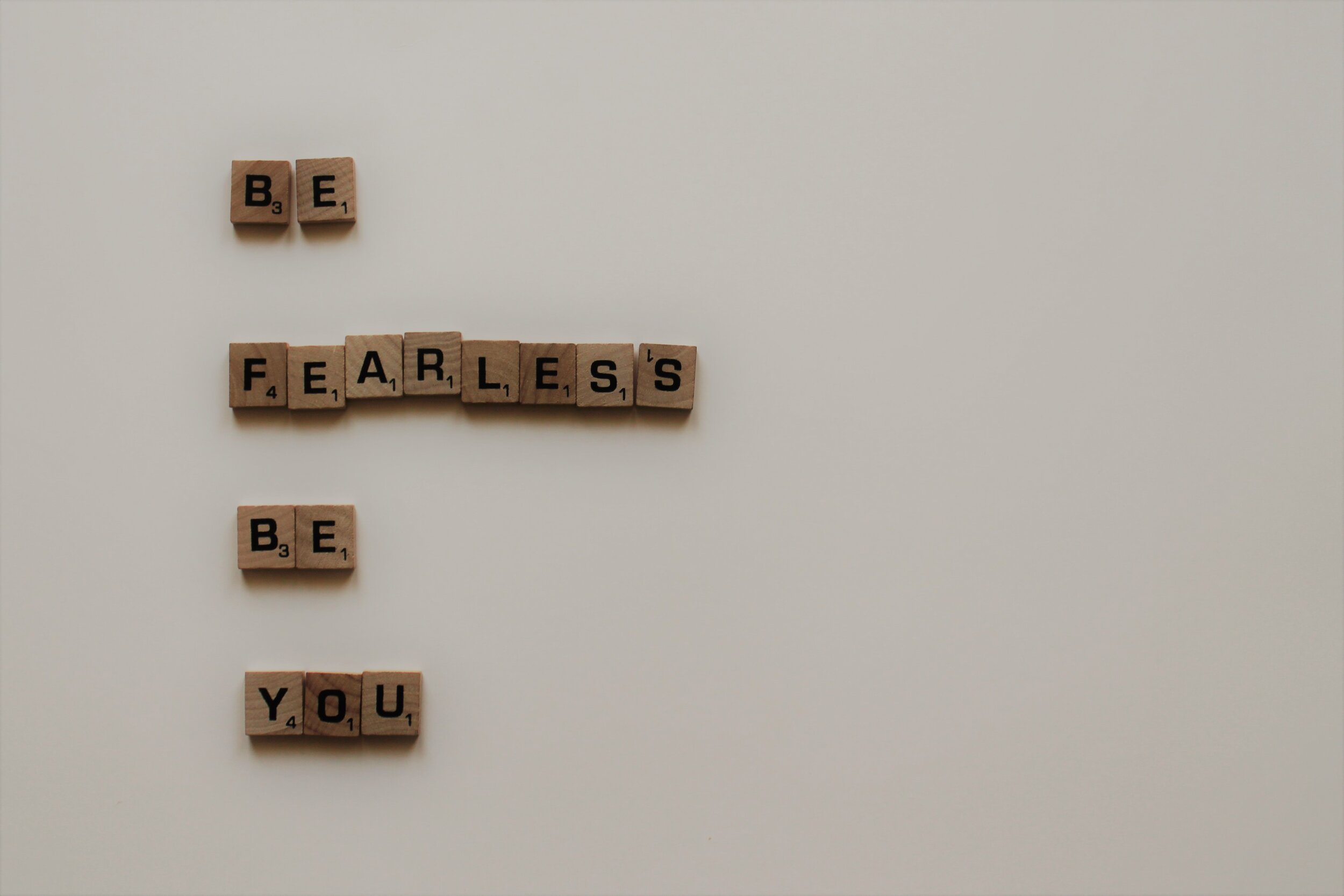
What binds these memes and sayings together is an understanding that “common sense is not so common.” These often are little notes passed from one person to another to remind or teach us how to live. Like self-help shots of wheatgrass for our minds that will help us in understanding how to live. Learning how to live It is one of the key virtues of self-help. It does not make self-help bad, but it does make self-help limited in what it can do because there is something more important to learning how to live.
That is where religion stand in contrast to self-help. Christianity, at its best, teaches us how to die more than it teaches us how to live. Christianity teaches us how to die, before we die. We cannot experience or have resurrection, new life, regeneration or new life, until we first die. Perhaps it is not a shock that self-help is more popular to pass around.
The irony of course is that only in learning how to die do we learn how to live abundantly, faithfully and eternally.
Before we go off thinking about how to live, perhaps take some time (years perhaps) to learn that which is more important.
Better to Eat Meat and Drink Wine Than Eat the Flesh of the Brothers
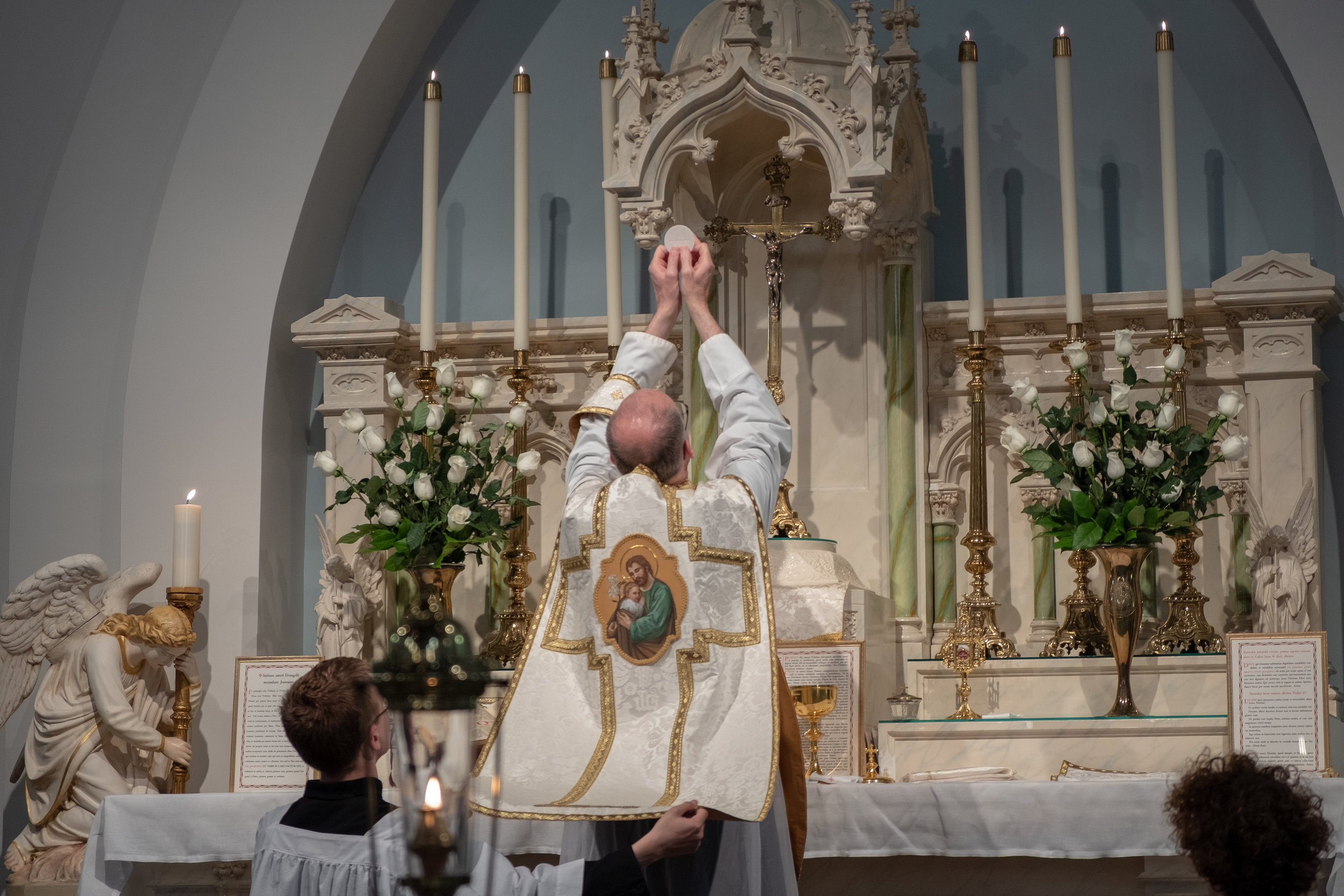
At Saint Mary’s University between 2002 and 2004, I was employed by the Campus Ministry Department. I was one of two “Ministerial Assistants” of the six or so people who worked in Campus Ministry. What that meant was that I was responsible to help the priests in Mass, tidy the chapel and ensure the two sacristies were in top shape. I was a crucifer, an Eucharistic minister, censer bearer, candle lighter and supplied a new host in the monstrance. The Father who hired me knew that I was United Methodist (and thus, not Roman Catholic) but it took the rest of the staff about a year to discover this not-withheld-just-never-mentioned fact. There were some questions, but the depth of our relationships were such that they knew where my heart was. Ecclesiastical differences were trivial.

Not a St. Mary’s Chapel, but my job would be the guy holding the cape.
Of course one of the big questions that I was asked with was around communion. As a Ministerial Assistant, I was privileged to handle the bread and the consecrated hosts. I put the consecrated elements in the tabernacle. I genuflected and bowed appropriately, or at least well enough that it took a year for someone to notice I lacked the smoothness of motion that comes with years of practice. I continued to hold to the United Methodist stance on the sacrament, but I respect transubstantiation even to this day. Communion or the Eucharist is a sacred thing and I was honored to serve at St. Mary’s University as the first non-catholic hired as a Ministerial Assistant.
One of the things that I came to appreciate in the countless opportunities to serve in Mass was the beauty of eating the actual body and drinking the actual blood of Christ. Before any theological argument breaks out over transubstantiation, or consubstantiation, or symbol; before our minds consider how cannibalistic the act of eating Christ sounds.; before we think about the difficulties imaging that bread and wine become body and blood, perhaps we can consider one truth:
We consume one another all of the time.
Benedicta Ward translates a saying of Hyperichius, ‘It is better to eat meat and drink wine than eat the flesh of the brothers by disparaging them.’
Through our language and through our actions we devour one another all of the time. Consider the headlines after a debate between two people. Someone always “slaughters” the other one. Sometimes they are “crushed.” If the conversation was good we might even say we were “consumed” in the moment.
With this in mind, transubstantiation, or consubstantiation may not sound as difficult to imagine. One of the differences is that when we consume another, we often do it out of violence. That is to say, we consume one another often against the will of the one being consumed. While in the Eucharist or Communion the one being consumed (Christ) is offering himself for consumption. It is as though Jesus says, “Rather than devour one another in violence, I offer myself.”
Jesus also says, every time you eat and drink do it in remembrance of me. We often limit ourselves to thinking about ever time we sit down to eat a meal. However, what if Jesus meant every time you want to consume someone or something, remember the one who freely gave himself for all to consume.

Be the change by Jason Valendy is licensed under a Creative Commons Attribution-NonCommercial-ShareAlike 3.0 Unported License.