
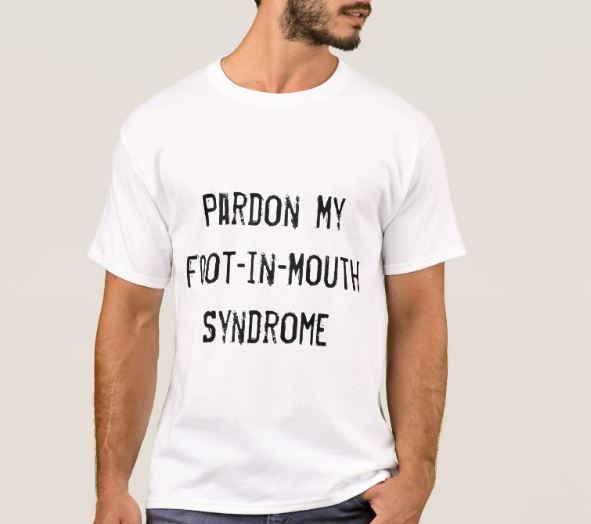
Diagnosed with “Foot in Mouth” Syndrom
One of the things about being a pastor is trying to strike up conversations with people who have varying degrees of expectations of what a pastor is/does. Some people desire that the pastor know a lot about their lives while others have the pastor on a need to know basis. I am still learning to be comfortable with who I am and as such I tend to over-function and want to try to meet others expectations of me rather than focus on what I am called to do/be.
This over-functioning in order to try to meet the expectations of others leads to the diagnoses of “foot in mouth” disease. Perhaps you have this diagnosis as well? Let me share a few of my more memorable afflictions:
- I asked a seminar leader for specific advice before the conference began. When the conference began the first rule that was shared was not to bother the leader with specific advice. The leader looked right at me when the rule was shared.
- I asked if someone got some sun over the weekend, only to be told that the redness is a skin condition.
- I stood on the General Conference floor (the governing body of the entire UMC) and asked a three minute question in order to clarify where we were in the proceedings in the hopes of moving the body forward only to be told after the explanation that all I had to do was say, “I call the question.”
- I said the wrong last name at a wedding.
- I gave looked Joe in the eyes for a year as I said, “The body of Christ broken for you Joe.” Only to be told when he moved that his name is not Joe.
- I welcomed a family to worship and asked their son if he liked superman. The parents shared with me that their nine year old was their daughter.
- I asked a member of AA if they ever wanted to get a drink with me to talk about their life I would open to that.
Perhaps you have your own situations. I share these in order to remind us you that we all mess up in social situations. I have foot in mouth. Sometimes I mess up so bad people leave the church or I just embarrass myself or make it awkward. I wait patiently for a cure for Foot in Mouth, but until then I trust in the Grace of God and God’s people when I step in it.

Christianity is not about seeking information; but being in formation
Lately I have been engaged in a book by Mike McHargue called, God in the Waves. While reading this book I am reminded that the divide in the world between the Christian and the Scientist is a false distinction. There are more than McHargue who work to talk about religion and science as compatible and those are interesting conversations. What McHargue makes the case for in this book is the approach of an individual to life and that being a person who seeks out information is not necessarily the same person who seeks out being in formation.
The great Abraham Joshua Heschel said that the action purifies the motive. Neuroscientist Dr. Adele Diamond gives this example of what Heschel meant:
He (Heschel) said, “I don't care why you're doing the good deed. Do the good deed.” And the example he gives is a musician may be playing a concert to earn a lot of money. But if when he’s playing the concert he’s concentrating on all of the money he’s going to make, he’s going to play a lousy concert. While he’s playing the concert, he has to be in the moment. He has to be concentrated on the music. And if he’s concentrated on the music, he’ll play well. So he talks about how the act can purify the motive if you really do the act fully.

McHargue speaks of prayer and invites the reader to practice prayer even if you are atheist. This may make little sense to some people but the point that I think that McHargue is making is that we often think that Christianity is the pursuit of information about a particular understanding of God. Thus, if one rejects the Christian information then one rejects Christianity. The problem is that Christianity is not the pursuit of information but the pursuit of being in formation.
Being in formation is taking on practices that mold and shape our heart, brain and spirit. The difference between information and being in formation is that one does not have be believe in order to be in formation. This is the hope that I want my Christian sisters and brothers to understand - belief is not the essential matter to be a disciple of Christ because Practice purifies the motive. We are called to follow Christ, we are called to be in formation; not to seek the right information.

Leaving and Going #UMC and #WCA
In full disclosure, I was not at the initial gathering of the Wesleyan Covenant Association on Friday, October 7, 2016 in Chicago. This is not a commentary on the WCA's actions at all but the underlying conversation present in many of the UMC leaders: schism.
Right now there still seems to be a battle over who is leaving whom. It is a defense mechanism to all parties to say that "they" left "us" and that "we" did not leave but held fast to the "true" expression of the denomination. I get it. In Christianity, perhaps only in the USA, there is a bit of a stigma to leaving. Leaving looks like you quit and were a failure, and there are only a few things that American Christians hate more than quitting and failure. So no one desires to be the one who "leaves".
In the battle for language, it is much more effective to communicate that you are not "leaving" but that you are "going" somewhere. When you say you are going then it looks like you have a mission and a purpose; that you have a righteous calling that you are "going" to live into. Going is much better than leaving in part because of the assumed righteousness in "going".
From what I could see on the #WCA2016 Twitter feed, there was a lot of talk about "going". Here is a sampling of the feed:
We are here to move on, to push forward. We are moving on to fulfill God's purposes in this generation. - Jerry Kulah #WCA2016
— Kristin Mahoney (@KristyMahoney) October 7, 2016
Going on offense... Building for the Kingdom. #WCA2016
— Chris Howlett (@kyblues) October 7, 2016
@aaronjmansfield #umc folks need to keep going whereThe Spirit is &from what I seeHe was at #NewRoomConf & #WCA2016.If we ask we'll see more
— Kathy Button (@kdbutton) October 8, 2016
This is a small sample size of tweets, but a quick search of "leaving" on the Twitter feed returns a couple of responses that are about how excited people are leaving their home in order to attend the conference. The sentiment on Twitter gives the impression to this outsider that the desire of the WCA is that of "going" and not "leaving".
I don't want to read too much into the tea leaves, but I raise this matter as a point of caution that there is a difference if you say you are "going" or if you are "leaving". The WCA may feel like they are "going" but it feels like the WCA has already left.

Be the change by Jason Valendy is licensed under a Creative Commons Attribution-NonCommercial-ShareAlike 3.0 Unported License.