

What is was like in the #SCJ16 room when it happens (extended post)
A few posts ago I shared about how I desire to be a person helping move the UMC forward with a sense of God's vision rather than just someone in the room when it happens. While I was only an alternate delegate, I was given the opportunity to participate in the election of bishops for about 25 ballots. Here are a few observations of what it was like in the room when it happened.
First of all, when a bishop is elected there is a Spirit and an energy in the room that is very unique. This sense of anticipation and possibility seasoned with our culture's fascination with personalities means that when a bishop was elected the room erupts in applause, cheers and singing. Even without a song leader, the body sings the doxology. Many church leaders cannot carry a tune (I count myself in that), but in a corporate body the common voice is sweet as it comes. It is a beautiful Spirit that feels as close to unity that we come as a Church body. The new Bishop is 'pinned' with the Episcopal seal and then taken away to sign papers and have a press conference. After thirty minutes or so, the new Bishop joins the council of Bishops on the stage and the glow on the Bishop is like that of a newlywed. I hope that everyone has the chance to be in the room when this happens.
At the South Central Jurisdiction (SCJ) there was great gridlock for the next two elections. Here is what I observed in the room when that happened.
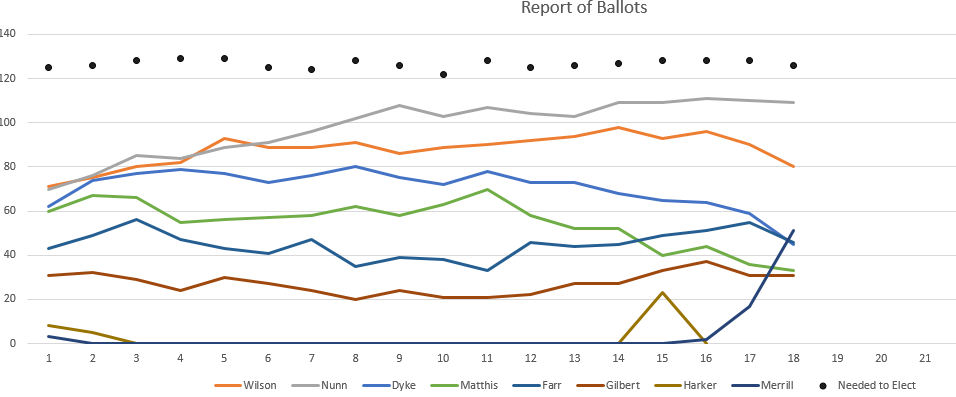
Below is a graph showing the first 18 ballots (excluding Bishop Saenz who was elected on ballot #3). As you can see there is a bit of a horse race and that (now Bishop) Nunn lead the pack for most of it. You may be asking, "if he leads the ballot total for so long, why not just elect him?" There are a few things I heard.
First there is great reservation to elect another Bishop, regardless of qualifications, from the state of Texas. Texas is over-represented in the SCJ council of Bishops. Nunn plateaued in part because he was from Texas. Additionally, there was a concern from others that the SCJ needs greater diversity of people on the council, which might explain why Wilson (Native American) held second and (now Bishop) Farr began to fall off while both Harker and Merrill (women) were introduced late in the voting.
So there are a few things going on, but all in the name of diversity - regional diversity, racial diversity, theological diversity, gender diversity, etc.
A few ballots later, Bishop Nunn was elected, and it was a good thing, but clearly not as exciting as the room was growing tired. As there was still one more Bishop to call, voting continued. There were a few formal exits from individuals and this was the picture after ballot 24:
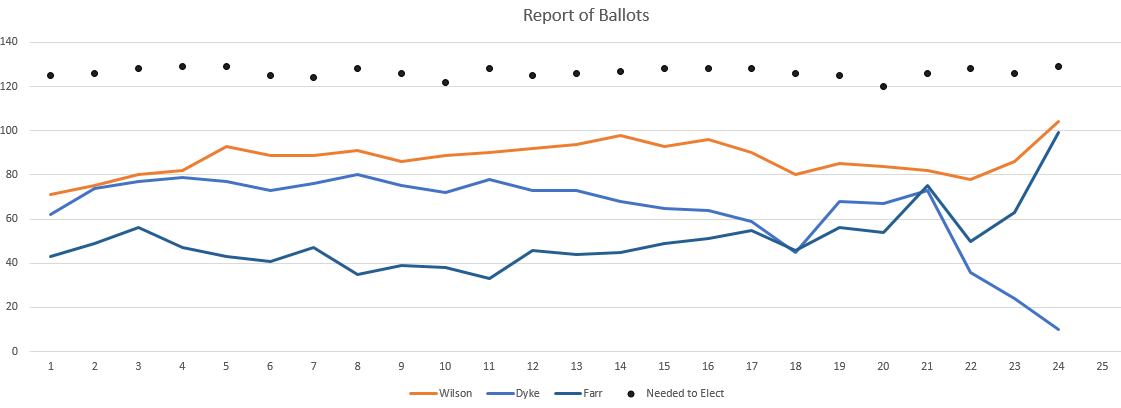
As you can see, Wilson was slightly ahead of Farr while Dyke was pulling into the high teens. This would be about as close the SCJ would get to break the long tradition of not electing anyone from the Oklahoma Missionary Conference and Native American - Rev. David Wilson. You may be thinking, "if diversity was the issue and all candidates left were non-Texans then why did the SCJ select Bishop Farr over Wilson or Dyke?" I asked this question to other delegates and quickly realized that was a newbie question.
I thought these elections were about selecting those being called into the office of the Bishop. Put another way, I assumed that these ballots were an attempt to answer the question, "Who do we feel is called to the office of Bishop?" What I discovered is that while this question is asked, there is also another unspoken question being asked when casting ballots for Bishops: "where do we put them?"
It makes sense. If you elect a Bishop they have to have a place to serve. However logical this question is, I feel it is out of order when it comes to electing Bishops for at least two reasons.
First, those voting are asked to vote on Bishops, not on placement. Placement is the work of the Episcopacy Committee. Loading unstated questions into a vote contributed the gridlock that we encountered. Those in the know, are asking this question and those who don't know are not asking this question. So there is another layer to why those following on Twitter may not see - you may be like me and assume the vote is about Bishops when in reality is it about Bishops AND placements in one vote.
The second reason this dual question in one vote is out of order is that it undercuts the itinerant nature of our denomination. It is the reason that we have a Board of Ordained Ministry (BOOM) who identifies those who are called and then there is the Bishop and cabinet who puts those pastors into positions. BOOMs do not reject a candidate for ministry because there is not a church "clamoring for that candidate." The BOOM qualifies and then Bishop appoints. Trust me, if the BOOM had to find a church that would have wanted me as their pastor prior to my ordination, I would not have been ordained!
At long last, Bishop Farr was elected (on ballot #35) and the SCJ's work of election came to a close. Those who desired greater ethnic or gender diversity were disappointed that the SCJ council of Bishops are 80% white males, while those who wanted a non-Texan were excited. It was late into the night, and I left the conference at 2:00pm the last day and did not experience the Spirit of the room when Bishop Farr was elected.
The work of the Episcopacy Committee began their assignments and with these announcements it was clear that I am perhaps too naive for this work because I thought the SCJ was a discerning body when in fact it is a deciding body. Here is what I mean by the difference in discernment and decision.
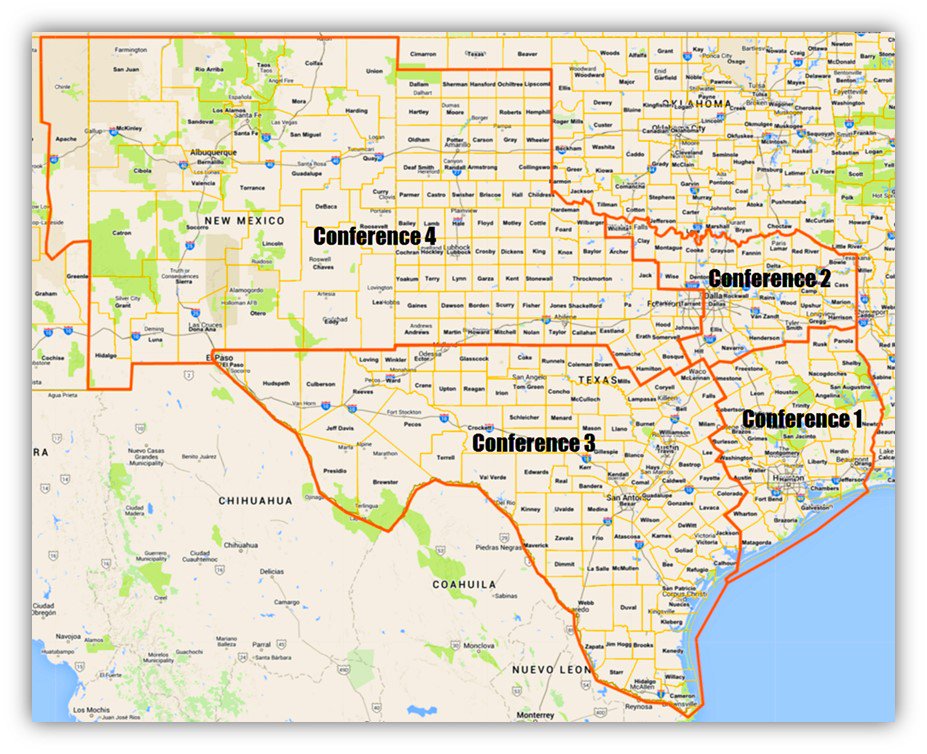
This was the map that was adopted as a starting point for future boundary discussions to happen in the coming years.
These two actions are not opposed to each other. There is often a decision that comes from discernment to be sure and that is a good thing. This is what I expected at the SCJ Conference. The body comes together with a sense of things, but things are not predetermined prior to arrival. The SCJ at times felt less like a discerning body and more like a deciding body, meaning it felt like we came to the SCJ Conference with our minds made up on who we wanted as a Bishop and even who we wanted to send where. When we enter a process with our minds already made up, we are no longer in the process of discernment - we are in the process of deciding. Again, not a bad thing, I just expected less emphasis on deciding.
There was much more that happened at the SCJ Conference including where conference lines might be redrawn, a report from a volunteer Korean Ministry director who through broken English was so proud to share that one of their own was accepted into the North Texas Conference (he said, "This is BIG news") and even a reaction/response to the election of Bishop Oliveto in the Western Jurisdiction.
There is a sense that one person can do so little even when the voting happens. If the infrastructure of relationship are not there prior to voting then one can feel helpless and unable to help the body. I am proud to serve my conference in the SCJ Conference and now that I have been in the room, I have a better feel for what it takes to make things happen.

Reciting Creeds: Act of Humility and Justice
Creeds are interesting in that they serve several functions in the Christian tradition. For many they are seen as a litmus test for who is Christian and who is not. I would submit that this is a misuse of the creeds of our tradition and to distill their role as just a test we all sign off on cheapens the richness of the creeds.
So what else are creeds?
I would submit that reciting the creed in corporate worship is more an act of humility and justice rather than a way to decide who is in and who is out. The creeds stated in worship, for the most part, are older than the people speaking them today. And this highlights why recited creeds are an act of humility and justice. Because these words are not "our" words means that we must stop talking and speak the words of others. When we speak these words we are humbled with the reality that others might have something to teach us.
Even more than that, when we give voice to the voiceless we participate in a act of justice. While the creeds are often written by those in power in their time, those people are no longer in power. Said another way, when we give voice to the powerless we recall all those who are powerless and voiceless.
So when you say a creed, perhaps you do not believe all (or any) of the lines, that is okay. Say them anyway. Say them as a practice of humility and as an act of justice. Then go out into the world and continue works of humility so that justice may be made real for all.
And perhaps, that is the greater goal of our creeds.

Too Busy Making Monsters to See Children of God
One Sunday July 10, 2016 I invited members of the church to join in a one day fast to consider ways in which we individually and collectively create monsters of other people. Objectify people is never a right thing. Objects are often used, consumed and dismissed. We never should make a human being into an object.
But objects are not the only thing that turn people into, we also turn people into monsters. When we make another person or a certain part of our own selves into a monster, we feel like we have a righteous cause and the moral justification to kill that monster. Just like the mob in Beauty and the Beast wanted to gather together to "kill the beast!" We will become that mob when a monster is present.
Saul was a person who made others into monsters. The followers of the Way were not doing right by the tradition Saul was brought up in. These people claimed to the eat flesh and drink the blood of their leader. These “cannibals” worshiped a man named Jesus who was an enemy of Rome and even the Jewish leadership. Jesus was so bad that when given the option, the people chose to release a religious zealot named Barabbas instead of Jesus. These Christians knew their actions were evil which explained why they met in secret and even had secret codes and symbols. These Christians were, in the eyes of Saul, monsters.
Saul's conversion moved Saul away from making and slaying monsters. But this conversion was not on his own doing. He had an encounter with Christ. He was struck blind and needed the help of others. He fasted for three days. When his sight was restored, he was eyelash to eyelash with one of these Christian "monsters".
I believe that Paul's life is the archetypal Christian life and as such, the Christian must go through a conversion. While we cannot control the Spirit of conversion, we can make space for the Spirit to move us. While not formulaic, I asked anyone who would like to join me in a one day fast to reflect on ways we make monsters. In response to this invitation, I share with you some of the things I saw shared on Facebook.


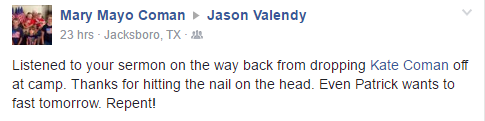
It is my prayer that we might have a conversion from identifying people as monsters to identifying people as beautiful, beloved children of God. If it can happen to Saul/Paul it must happen in us.

Be the change by Jason Valendy is licensed under a Creative Commons Attribution-NonCommercial-ShareAlike 3.0 Unported License.