

Why your pastor should love complaints

There are 150 Psalms in the Christian Bible and roughly 1/3 of them are laments. Laments are structured ways to complain against God and as Rev. Estee Valendy noted in her sermon, interwoven in the lament are expressions of faith and hope.
Humans love to complain but hate to hear them. Irony at it's finest. But the reality is, your pastor should love complaints. Complaints are ways for people to deal with their feelings and emotions. It is natural and healthy to share these feelings, remember 1/3 of the Psalms in the Bible are complaints. However, our culture does not like those who complain. So what are we to do with these feelings? Most of the time we push them down and do not allow them to surface except when we rehearse the script of what we want to say while we are driving. We do not have a healthy place to confront these feelings and complaints and they begin to fester in us only to manifest in other ways, such as road rage.
The fact of the matter is part of the reason pastors should love complaints is that there is one place left where complaints are accepted and heard - the Church. The promise of the Church is that when you come to complain, the Church will not leave you or cast you aside. The Church of Christ hears your cry and will not take it personally, but will have the courage to sit with you even as you cast stones at her.
Pastors should love hearing complaints because it means that people are finding ways to address their feelings in mature and healthy ways. And ultimately that is role of the pastor, to help people move toward maturity in Christ.
So I remind you that if you have complaints, don't push them down. Perhaps write them down, but do not fear your complaints. And if you are afraid of your complaints, then share them with your pastor. We are here to stand by you so you are not alone.

Confusing Harmonious with Homogeneous
You may have seen this image floating around the internet the past month or so.
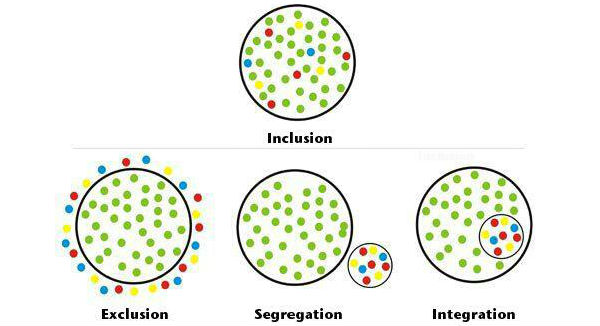
As you can see it visually depicts the difference between inclusion, exclusion, segregation and integration. Perhaps the most helpful aspect of this image for those of us in the dominate culture is the difference between integration and inclusion. While integration brings others into the majority there is still a resistance to include the other into the larger group.
From what I understand it is difficult for the blue dot to move freely in the sea of green dots for there is a concern that the blue dot will loose their blueness and identity and become more blue-green and then ultimately be seen as green and not blue. It is difficult for the blue to remain blue when they are surrounded by green, so the blue might want to stay closer to other non-green dots.
For those in the dominate culture, it is upon them to help move from integration to inclusion. It is upon the to foster a space where "greenness" is not forced upon the non-green. It is upon the dominate culture to protect the variety of colors/ideas/beliefs/religions/etc. Which means that the green dots must also come to see that creating a harmonious group does not mean creating a homogeneous group.
There is a lie operating in our world that conflict will go away if we all were more similar than different. That is just a lie. I don't know about you, but I am at times in conflict with my own self - I want a cookie but I don't want a cookie, I want to run away but I don't want to run away, I want to yell but I don't want to yell. Harmonious living does not mean homogeneous living. Harmonious living is learning to respect the differences.

Prayer, why we may fear it
Tefilah is the Hebrew word English translates as "prayer". Recently it has been revealed to me by Rabbi Chava Bahle that this is a poor translation. In English, the word "to pray" means to beg or beseech. The problem is that tefilah does not mean that. Rather it means to 1) self-reflect and 2) taking a wide range of things and unifying them.
The point being that prayer is a tool God uses to change us rather than a tool we use to change God.

Prayer is also the practice of being able to step back and reflect on how it is that contradictory things are actually unified in some way. Being able to "see" the unity in the midst of a broken world is very important. The genius and beauty of the Lord's Prayer is Jesus' ability to take a wide range of things (thankfulness, the greatest commandment, hope, dream, praise, etc.) and put them all together. Additionally the prayer takes things that seem contradictory and unites them, such as praying that heaven will come on earth.
Prayer changes our hearts and helps us see. This is why those who pray know the power it has to change us. Perhaps that is why many of us do not pray - at some level we know it will change us and we fear that change.

Be the change by Jason Valendy is licensed under a Creative Commons Attribution-NonCommercial-ShareAlike 3.0 Unported License.