

Confusing Harmonious with Homogeneous
You may have seen this image floating around the internet the past month or so.
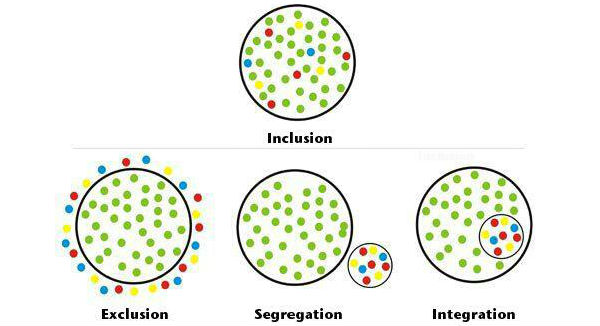
As you can see it visually depicts the difference between inclusion, exclusion, segregation and integration. Perhaps the most helpful aspect of this image for those of us in the dominate culture is the difference between integration and inclusion. While integration brings others into the majority there is still a resistance to include the other into the larger group.
From what I understand it is difficult for the blue dot to move freely in the sea of green dots for there is a concern that the blue dot will loose their blueness and identity and become more blue-green and then ultimately be seen as green and not blue. It is difficult for the blue to remain blue when they are surrounded by green, so the blue might want to stay closer to other non-green dots.
For those in the dominate culture, it is upon them to help move from integration to inclusion. It is upon the to foster a space where "greenness" is not forced upon the non-green. It is upon the dominate culture to protect the variety of colors/ideas/beliefs/religions/etc. Which means that the green dots must also come to see that creating a harmonious group does not mean creating a homogeneous group.
There is a lie operating in our world that conflict will go away if we all were more similar than different. That is just a lie. I don't know about you, but I am at times in conflict with my own self - I want a cookie but I don't want a cookie, I want to run away but I don't want to run away, I want to yell but I don't want to yell. Harmonious living does not mean homogeneous living. Harmonious living is learning to respect the differences.
Prayer, why we may fear it
Tefilah is the Hebrew word English translates as "prayer". Recently it has been revealed to me by Rabbi Chava Bahle that this is a poor translation. In English, the word "to pray" means to beg or beseech. The problem is that tefilah does not mean that. Rather it means to 1) self-reflect and 2) taking a wide range of things and unifying them.
The point being that prayer is a tool God uses to change us rather than a tool we use to change God.

Prayer is also the practice of being able to step back and reflect on how it is that contradictory things are actually unified in some way. Being able to "see" the unity in the midst of a broken world is very important. The genius and beauty of the Lord's Prayer is Jesus' ability to take a wide range of things (thankfulness, the greatest commandment, hope, dream, praise, etc.) and put them all together. Additionally the prayer takes things that seem contradictory and unites them, such as praying that heaven will come on earth.
Prayer changes our hearts and helps us see. This is why those who pray know the power it has to change us. Perhaps that is why many of us do not pray - at some level we know it will change us and we fear that change.

More Humble Than Proud
In the Hebrew the word for humility carries with it a sense of knowing how much space to take up. When should you take up space in order to help those who need help and when do you need to take up less space in order to allow others to have space to breathe. It is a great image for me to consider that being humble has both a meek and a powerful side to it.
When I think of the word 'proud' I tend to think of a person puffing out their chest, sometimes in healthy ways (such as when a good job is done) and sometimes in a unhealthy ways (such as when talking about how awesome you are). Proud always takes up more space while humility knows what is the correct space to take up.
For reasons I do not know, we are writing and talking less about being humble and more about being proud (see Ngram below). The spiritual life is one that is not afraid of being proud, there are healthy times to take up more space. However, the spiritual life is knowing when to take up less space. Proud is fine, humble is greater.

Be the change by Jason Valendy is licensed under a Creative Commons Attribution-NonCommercial-ShareAlike 3.0 Unported License.