
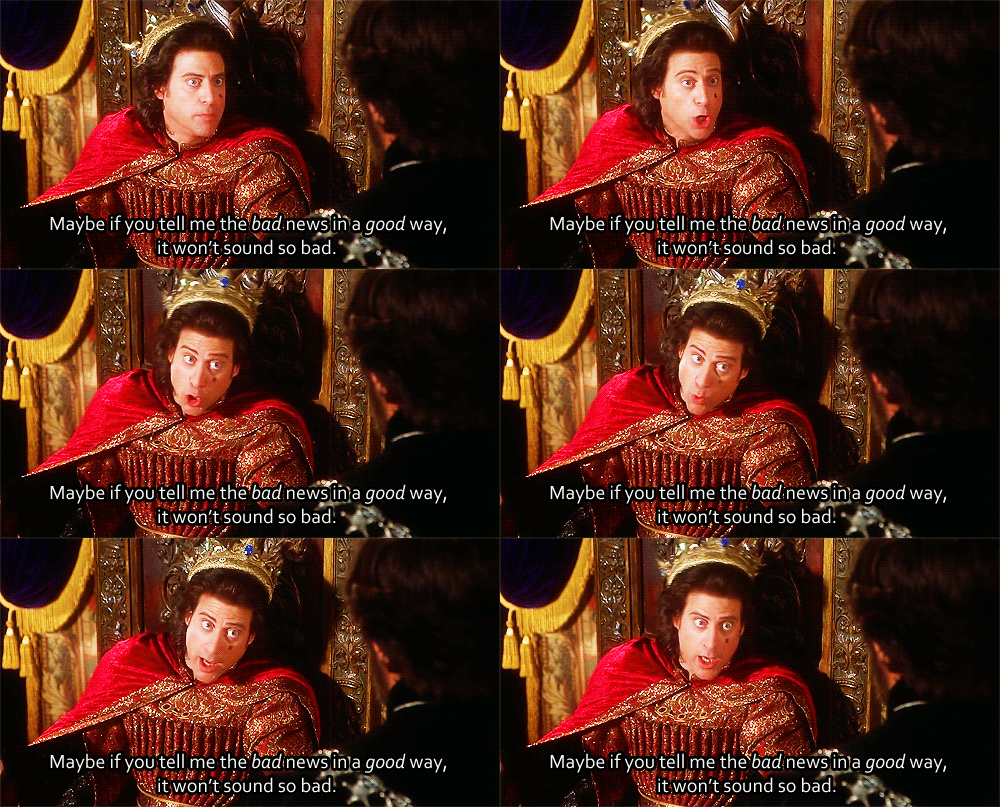
The empty tomb of Jesus is Bad News
Christianity has taught that the empty tomb of Jesus is not just good news but The Good News. The death and resurrection of Jesus is the defining moments of the story of Jesus and it shows us that death does not have the last word. That life and light cannot ever be overcome. This is indeed Good News.
But it is also bad news.
We are a people who are trapped by scapegoating and sacrificing others in order to "eradicate" problems in the world. We are always on the lookout for the person or persons that are responsible for the problems in the world and then doing our best to demonize those persons so that our scapegoating actions are justified. We all know that the President of the USA has power but the President is not all all mighty puppet master that can make the sun rise and gas prices low. We like to think that the POTUS has all sorts of power to "fix" the world or at least our problems. If we read biographies or memoirs of previous POTUS we quickly see just how limited their power is.

And yet, we blame them for all sorts of problems which we think they caused. Low stock market? Housing bubble? Middle East crisis? Health care costs? All of these and many others are beyond the actions of the POTUS. These are complicated problems that require massive solutions that one person cannot do on their own.
We are a species that is addicted to finding scapegoats in our world. We are addicted to blaming and shaming and killing others. Ae are a species that is addicted to filling tombs with people who are the "problem".
When the tomb is empty, it is Good News. But it is also bad news for us who are addicted to scapegoating and sacrificing others. The empty tomb says that God does not accept sacrifices and scapegoats. It says that the tombs we try to fill will forever be emptied, that our thoughts on who is to blame and who is the problem are incomplete.
The empty tomb is bad news because it pricks the hearts of us all that the way we are working to bring about peace has been and is all wrong. We have to find a "more excellent way". We have to give up filling the tombs with victims before an empty tomb can be Good News.
Is the Desire for Accountability Accelerating the Erosion of Faith
Perhaps the number one asset a pastor has is trust. It is something that is developed over time and it is something that is non-transferable to another pastor or from one church to another. It is a precious source and it is why so many people wounds run deep when pastors violate trust.
For reasons that I cannot fully understand a current buzzword in Church leadership is accountability. It is seen that because trust has been violated by some that we need to do what we can to reestablish trust within churches. Accountability measures are thought to be the answer. If we can hold people accountable to their actions then we will re-establish trust.
I wonder if it is the accelerating the erosion of trust in our church and perhaps beyond.
For instance, if I do not trust the people that work under me to do their work, then I may install software on their computer to block sites and monitor their activity. However, if I trust my employees to tend to their tasks, then monitoring their internet usage could potentially hurt my relationship with my employees. While I may feel better so that I can hold my employees accountable, my employees now no longer trust me to trust them. My employees begin to resent that I no longer trust them and will, in turn, begin to ask how is the boss being held accountable to my work. The employees being to wonder if I the boss am wasting company time and will begin to resent that they are not trusted to do their work and the boss is without any accountability. Is it no wonder that one agency found that over 52% of employees do not trust their boss? (If you have access to The Office episode titled "Email Surveillance" then you can see this situation dramatized in a funny way.)
The cry for accountability, in my experience, seems to be an expression of a lack of trust. And because trust is difficult to gain and easy to lose it makes sense that we would want to find a shortcut to get to the place where we can all trust each other. Accountability measures are being pitched as something of a silver bullet to arrive at Trust. If we can hold one another accountable (i.e. exact punishment and rewards on people with data to back up the decision) then we will build trust faster - I know what you are doing and can see you are trustworthy and you know that you are being held accountable to me and thus you work to prove your trustworthiness.
One of the understandings of the word Faith is trust. I have faith that the driver in the other lane will not veer into my lane - I trust the other driver. Christianity is a religion built on faith as trust. God trusts humans with creation care and humans trust God to provide for creation. Can you begin to see how it can be that if we do not trust our neighbor or employee without feeling like we have to hold them accountable then how could we learn to trust anything else?
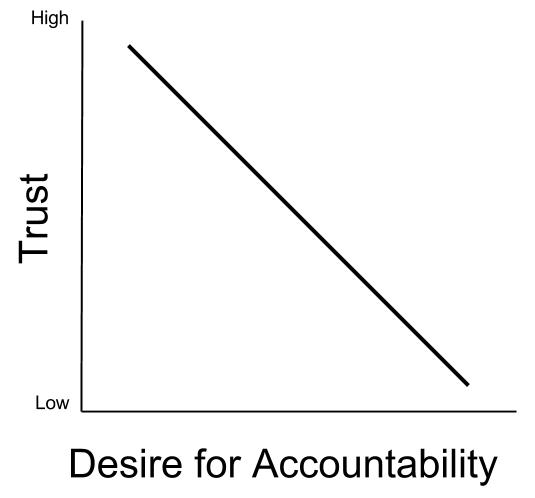
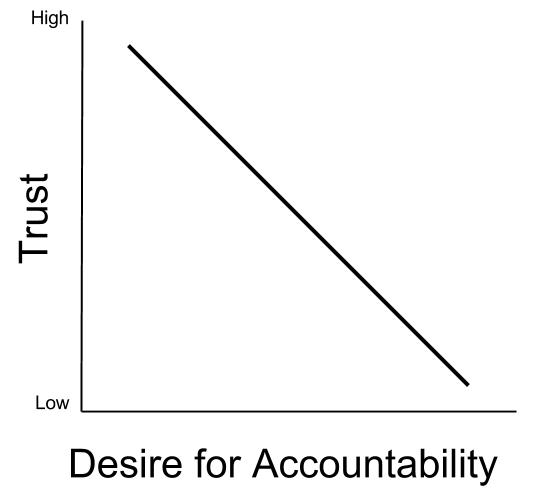
It just makes me wonder if accountability and trust are on two different sides of the spectrum. The more trust you have the less desire for accountability and the less trust you have the more desire you have for accountability.
Is the Desire for Accountability Accelerating the Erosion of Faith?
Even Jesus Could Not Convince Us
There is a story in the Bible of two disciples of Jesus walking to town called Emmaus. These two disciples are talking about all that had happened in the following week in which their teacher was condemned and killed and apparently raised from the dead. While they were talking a third man came upon them and heard what they were talking about. This third man asked of whom they were talking about and the original disciples are floored that this stranger had not heard about what happened to Jesus over the past week. The disciples shared how they had hoped Jesus would have been a particular type of leader only to have their hopes dashed by Rome.
This stranger then went on to talk about how the two disciples really do not understand the scriptures and how it was important for the messiah to be killed and raised from the dead. In fact the stranger goes through the entire story of the Hebrew scriptures trying to show them that in fact they have misguided expectations about the messiah.
The two disciples are not convinced. They invite this stranger to share in a meal only to discover at the breaking of the bread that the stranger is no other than Jesus Christ himself!
There is much to talk about in this story but perhaps it is worth noting that even Jesus Christ could not convince two of his own disciples through arguments and sharing of ideas.

If Jesus cannot convince his own disciples to change their hearts through arguments, how can any Christian expect to change the hearts of others through arguments?
It is only in the breaking of the bread that the disciples' hearts are changed. It was only through relationship and meals and fellowship and being vulnerable that they could see Christ.
Rational arguments are really only good to help you confirm what you already believe. Few people's minds (much less hearts) are changed from rational arguments. But the world was (and still is) changed through relationships.
May we stop arguing and begin breaking bread.

Be the change by Jason Valendy is licensed under a Creative Commons Attribution-NonCommercial-ShareAlike 3.0 Unported License.