
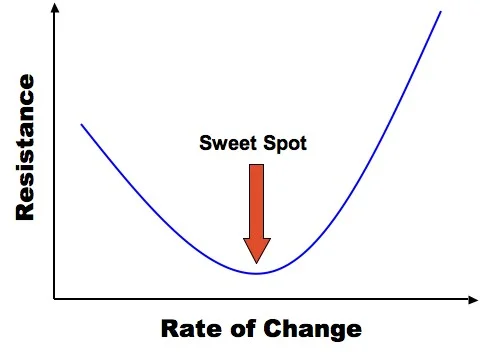
Are we better off with changes rather than just change?
Girard is a thinker who brought to my awareness that if the tension of world is not dealt with then the "social fabric will burst". The dominate way we deal with tension in the world is by scapegoating someone or something. Through the discrediting, removal or killing of the scapegoat the tension is released and the group is brought to a temporary peace. But because this "remedy" requires ongoing violence towards the people within the system , Girard reminds us what Jesus said, "a kingdom divided against itself cannot stand." Thus this cycle of violence is leading us toward destruction and not toward the promised peace.
In order for this system to work the group needs to be unified against the scapegoat. The majority of people have to believe that "this" or "that" is the reason there is tension in the community. You cannot have a witch hunt if there is not a mob who believes that some (not all) people are witches.
If unity of the mob in their disdain of the scapegoat is required for the cycle to "work" then what would happen if the group could not unify against an agreed upon scapegoat?
Would this mean that we would have to deal with our tensions in ways other than by identifying and destroying a scapegoat?
When I was in seminary I was trained that to make changes in the church one must be slow because too much change too fast creates it hard for the church. We were told that "change is hard" and so any change must be approached with care and follow up. Over the past year I wondered if the slow rate of change actually gives people a ready made scapegoat that people all agree is "the problem".
When there is one change in the system it is clear to everyone that the change is being made and then everyone is focused only on that one change. Everyone who is angry about the change builds a backing because everyone is focused on this one change. Those who are not angered over the change can be caught up in the growing frenzy as they see what looks like a growing number of people who are really upset.
Soon enough, there is a mob unified against the change and there you have a mob against a scapegoat. And the mob will do what mobs do to scapegoats.
The church I am in ministry with has gone through a number of changes one after the other. Staff changes, worship changes, infrastructure changes, structural changes, leadership changes all happening over the course of the year. What has become clear at this stage in the game is the grumblings that I hear are minimal and fractured. That is to say, there is not a unified mob.

Does multiple changes refract the tension in the community so that the community cannot rally against a single scapegoat? And if the community cannot rely upon the scapegoat mechanism to resolve the tension, does the community find healthier ways to deal with the tension?
I found Grace in Mexico circa 2003 (pt. 2)
Story of Grace continued from previous post.
I have never killed an animal before, but if every animal was killed the way Chon killed this cow, then I would be willing to bet PETA would have a different argument for animal eating.
The next several minutes were a blur as I watched Chon begin the quartering process. After a while, Chon handed me a knife and showed me how to removed the skin of the cow and even gave a smile when I messed up.
Before this experience the closest I had gotten to slaughtering an animal was when Han Solo kills a Tauntaun for warmth. So with all my vast knowledge of dead animals you can see why I had reason to be concerned about contracting Mad Cow, Salmonella, Herpes. Which explained why I moved so
After some time, we quartered the animal and then loaded each quarter into milk crates then loaded the crates into the back of the truck. Through a series of taps and points Chon communicated that I would ride - with the cow. I was there to ensure nothing spilled or fell out of the truck.
I rode all the way back into the village with a cows head staring right at me.
In the village Chon took the morning's work into his shop where he cleaned and then continued to prepare for the afternoon sale. Watching his cleaver and knives move so effortlessly was hypnotic and again Chon invited me to join him.
At one point Chon removed the tenderloin and wrapped it in three banana leaves. Chon took the tenderloin to the main square where he was the day's chef.
Once it was all prepared, Chon gave me a plate and a cerveza. Having lived to the age of twenty years old meant that I officially never had a drink of beer before. Having lived through my college freshman year meant that officially never had a drink of this type of beer before. (I do not endorse under-aged drinking)
Our guide must have sensed my mixed feelings of taboo and delight when he told me that if I did not drink the gift from Chon it would be a great insult. So with a smile, a nod, a clink of two bottles, Chon and I shouted, "Salud!"
He and I sat next to each other. I drank the gift. We ate from our work. We could not communicate to each other but we understood one another.
I don’t know if it was in the piea when we first arrived. I don’t know if it was in the coka or the beans and cheese or the shower water always prepared. Perhaps it was the fact that my room was half of their home or the breakfast prepared each day for me. Maybe it was the tenderloin, the sharing of his craft, or the cerveza. I don't know, But somewhere along the way on this trip I experienced offerings that showed me what Grace is like.
My faith grew.
My faith in the interconnectedness of all humanity. My faith in the goodness that resides in each of us. My faith in a God that does not abandon us in the rushing mobs the busy streets. My faith in the power of the shared meal. My faith in the assurance that generosity is the law of the land. My faith in the conviction that love transcends language.

I found Grace in Mexico circa 2003 (pt. 1)

After waiting in the Mexico City International airport for seven hours, riding in a car for an hour to get on a four hour bus ride only to be take to the "edge of the civilization", the nine of us were greeted by cattle trucks.
These pickup trucks with cattle cages over the beds drove four hours deep into the Uxpanapa valley where we committed to spend two weeks helping a small village of ninety people to build an irrigation system in the main plaza of the community.
We were greeted by many of the village who informed us that they had a treat for us down by the river - paella made in a pot deeper and wider than the river that we were invited to swim in.
After we gorged on the paella and bathed in the sun, we were taken to our host homes where we would stay for our duration. Chon and his family were my host family and their cinder block home was off the main road but not far enough off the road to avoid being noticed by the wild chickens and dogs.
The home had crude electricity, no running water and four rooms. Chon and his wife slept in the master bedroom that was sealed off by a sheet from the kitchen/dining space. The rest of the house was the living room, where the three children slept, and a storage space, where I anticipated I would sleep.
The family greeted me then the children promptly collapsed their sleeping cots from the main room and moved them into the storage space. Chon set up their best looking cot in the center of the main room, just below the only light of the space. This was my bed. They handed me a blanket and then we all prepared for a good nights rest.
It is written in some ethereal law that college kids cannot wake up prior to 8 a.m. and this was the case that first morning in Chon's home. What made the experience unique was the fact that my host family was all gone and desayuno on the kitchen table: eggs, black beans and cheese.
Rushing to get to my group's work I forgot my gloves. We were to remove the top soil of the large plaza, install drainage and irrigation ditches and lay sod. I was glad to get my gloves, because at the end of the day I was exhausted and sore all over.
To our dismay, the host families each came to see our work each afternoon bringing a Coka (bottled Coke) and invited us to lay in the breezeway hammocks. Never had sugar tasted sweeter nor woven cords felt so soft.
Chon's children brought me water each night prior to bed. Not to drink, but to take a shower with. They carried the water in the morning, while I slept. The only time I saw them carry the water was the morning Chon woke me up at 5 a.m. to invite me to come with him to his place of work.
Going with him was the least I could do! The man had rolled out the red carpet for me and forced his kids to carry my shower water. I had no idea what Chon did but I was more than happy to help him.
Chone drove his well worn truck out to the edge of the village and beyond the dirt roads into the center of a large field. We did not exchange any words as he drove but it was clear by the mood in the car that we were going to do some serious work.
About 200 yards in the distance was what looked like a cow grazing next to a barn. Chon got out of the truck and I followed. Asthe dawn broke I noticed that Chon wore dark blue jeans and a white long sleeved shirt. His clothes looked like "church clothes" compared to my muddy grey pants and torn t-shirt.
When we made it to the barn, it was apparent that the cow was tied to the barn with a long rope. While I examined the thickness of the rope and the rust on the barn, Chon rolled up his sleeves and pulled a tool bag from the barn.
The "tools" were knives. My heart quickened. The cow's eyes looked scared. Chon said a prayer. Three different creatures of God stood under the barn covering, unable to communicate but in that moment we all understood wat Chon's work was.
Modern American slaughterhouses are more of a assembly line with thousands of corn fed overweight cows pushed through double doors only to be electrocuted in the skull, slaughtered, then stamped with a meat grade all within a few hours. Chon's slaughterhouse was, well, different.
Spanish words came from Chon as he placed his hands on the belly of the cow and for a moment Chon the butcher looked more like Chon the priest. While I watched Chon, my college-aged brain began to wake up to the reality that I was there to help Chon slaughter a cow.
I was glad I had not had breakfast.
Next post will continue...

Be the change by Jason Valendy is licensed under a Creative Commons Attribution-NonCommercial-ShareAlike 3.0 Unported License.