
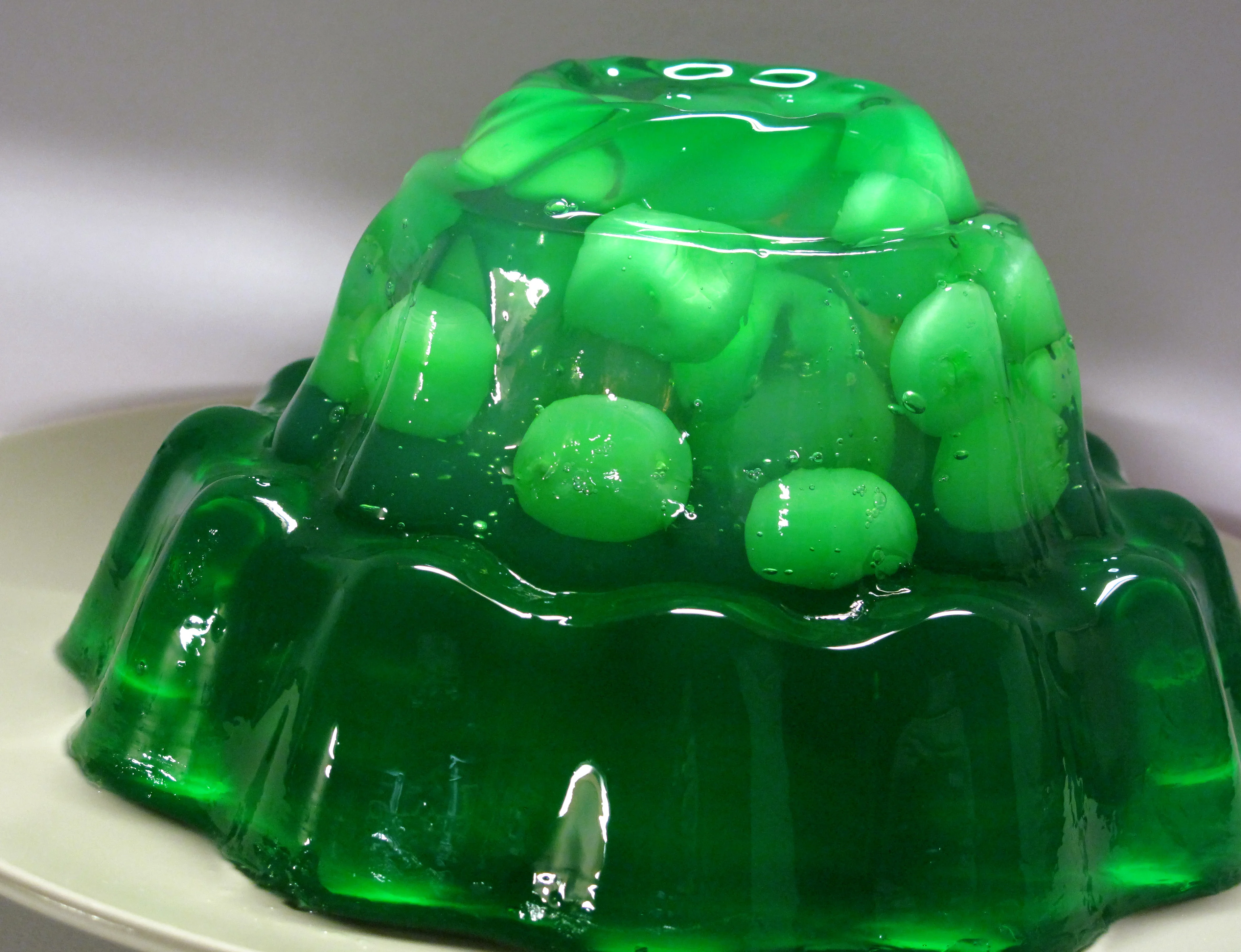
What prayer has to do with Jello, eggs and restaurants - Part 1 of 3
There are more people who talk about desiring to join a gym than those numbers of people who actually join a gym.
Prayer is the gym membership of the Church.
There are more people who talk about prayer than people who actually pray. This is true among the clergy ranks as well. I have been at many small meetings with clergy and there is no prayer at all. Not even a "God is great" prayer.
Could it be that perhaps all the talk and little action to the practice of prayer is that we do not really think it matters or makes a difference?
We tend to think that we are all individual people living individual lives and our actions are too small to affect anyone on any sort of scale. We also tend to think that unless we can physically see something then that something is not real. Or, put another way, we are really suspicious of all that “spiritual” stuff.
Prayer has fallen out of popular practice in part because we have bought into the idea that the only things that change the world are the grand projects. And while these grand ideas are needed, we forget that each grand projects is just a collection of much smaller projects. The beehive is very large, but it is the result of a bunch of small bees doing small amounts. Big things are the result of small things.
Secondly, we hesitate to take prayer too seriously because we cannot see prayer. We can see the sandwiches we made to go to the homeless. We can see the money we collect that goes to eradicate Malaria. We can see the hours we put into a home and see the improvements, but we cannot see prayer. And since we cannot see it, it somehow is less than that which we can see.
So for many prayer becomes something we do not practice at the levels that we talk about it.
Which is where Jello, eggs and restaurants come into the picture. This post will just focus on Jello.

Imagine a mound of jello with fruit and you have a fork. You are tasked to remove a piece of fruit without disrupting the jello mold.
You may be able to have no movement if you move slowly. But as soon as you pierce the fruit to pull the fruit out, and the fruit pushes jello out of its way to make room for it’s exit, you will disrupt the mold.
Quantum Physics says that everything is bound together by energy. And that what affects one particle affects the next. Christianity has stated for hundreds of years that we are all bound together as the body of Christ. And what affects your ankle, affects your knee, and what affects your knee, affects your hip, your hips affect your back and your back affects your shoulders. What affects one area of the body affects all areas of the body.
Prayer is like a fork on a jello mold. It is said that prayer is really more helpful for the individual praying than anyone else. I don’t know. What I do know is what affects one part of the body affects all parts of the body. And quantum physics shows that affects one particle affects all particles.
The next post - Prayer and eggs.
Clergy "secret" revealed
Recently I shared a story of my son who was "mortally wounded" by melted chocolate to talk about the power of rituals. There is even science supporting the power of rituals.
When I clergy go into a hospital setting, there is an unspoken ritual that takes place and what I have come to discover is that ritual is generally to quick to be meaningful for most people. Here is the ritual:
Greeting - physical contact with the sick - talk with people present - pray - leave
The only thing that separates a clergy visit from a visit from the doctor is a prayer at the end. It is as though prayer is an exit strategy for us or a way to put a Jesus shine on the visit. Clergy leave but people are left behind in the cold hospital room, waiting.
If it is true that the number of steps in the ritual matter, might I suggest all of us the way Jesus preformed rituals. Now we may not have healing powers, but look at the ritual Jesus does on John 9, verse bracketed for reference:
Addressed the crowd/ill [3], stated why he was preforming a ritual [4-5], used an external tool/element [6] and touched the sick [6], and gave a directive [7]
Could it be that this would be a better ritual for hospital visits? Maybe this is why it would be worth Protestants considering to draw from our lost tradition but not forgotten by our Catholic sisters/brothers - anointing.
Address the room - Hello my name is ______, Peace be with you.
State why you are preforming a ritual - In the tradition of the Church, I would like to anoint your head with oil so that you may know even when I have left that God is always with you and that you are never alone.
Use external tool - in this case, oil
Touch the sick - mark a sign of the cross on forehead
Give directive - "Christ is with you, this day and every day. You never walk alone. From this moment on may you remember that you are a beloved child of God and a valued member of this world. Remember that you are of great worth and that your life has touched the lives of many. Remember who you are and who's you are. Amen."
Pray.
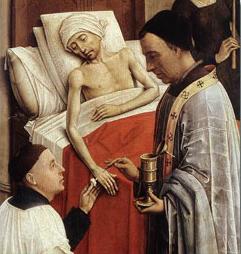
I have now done this ritual in hospital settings about twenty times. With a variety of people in different settings, but the response has been overwhelmingly meaningful. Generally a thank you follows the standard ritual, but this ancient ritual has brought tears, smiles, thanksgiving, recommitting to God, hugs and holy kisses.
And so, while this may not be something everyone feels comfortable doing, just like I do not feel comfortable putting an IV into someone's arm, I would commend clergy to consider the rituals we create and preform in the hospital setting.
Let us do a better job at showing the peace of God, the love of Christ and healing of Christ in a place that often times desperately needs it.
What is really hurting the church - sentimentality

I have a pair of clear glass bookends shaped like seals balancing a ball on their noses. They were from my grandparent's depression era glass collection. When I was younger I was impressed by the smoothness of these weighty statues. They less detailed than you might think and look more like 3D silhouettes as you look at them. I have carried them with each move I have made and presently they sit on book selves in my joint office.
I cherish these bookends. Some might look at them and see rather plane glass seals and they have some dollar value to collectors but to the average person, they are hunks of glass. To me however, they have sentimental value.
Often times, I confuse Love and sentimentality. When I look at the seals I remember the Love my grandparents and I share, and I think that if I throw those seals away the Love would go away with them. So I hold onto those seals in an attempt to hold onto the Love.
But the truth of the matter is, sentimentality is not Love. Well, let me rephrase that, it is love but it is self love.
Those things that have sentimental value mean that they only have value to the individual. And that individual values them because it reminds them of something that is unique to themselves.
It seems to me that the reason the church is "irrelevant" is not because the church is not doing relevant things. Heck there are still people going and joining churches all around. So it is relevant for some people. But there in lies my point.
As long as we choose a church based upon our own preferences and styles rather than choose a church that we can serve, then the church confuses Love with sentimentality.
What is really hurting the church is not the Love we have, it is the sentimentality we have.
The glass seal bookends in my office seem irrelevant to anyone who knows that I own more digital books than paper books. The only reason I keep them is because they have sentimental value. That is I love the feeling and memories they invoke in me.
As long as the church loves the feelings we get when we attend church more than we love the God for whom we worship, then the church confuses Love with sentimentality.
As long as we take more delight in the personal benefits of attending church rather than the delight in being a child of God, then the church confuses Love with sentimentality.

Be the change by Jason Valendy is licensed under a Creative Commons Attribution-NonCommercial-ShareAlike 3.0 Unported License.