
Rainbows and shrimp keeping us humble
recently had an episode that explored
.
One of the things that was covered in the episode was that the human eye has three cones which can pick up the colors that you and I see. Radiolab used the metaphor of a rainbow. You and I look at a rainbow and see the light break into that ROYGBIV combination.
Can you see the difference between eggshell and off white?
This shrimp can.
However, there are other animals which see different colors when looking at a rainbow. Some animals see few colors while other animals see more. When you listen to the episode you will learn of Mantis Shrimp that can see a huge array of color that humans could only dream of seeing.
That is right, compared to this shrimp, we are dramatically color blind.
It is humbling to know that there are other creatures out there that can see more than I can see. It reminds me that there are other people that can see what I cannot see. It reminds me that I am color blind on a good number of things.
Something to keep in mind as learn to live together.
The greatest expression of freedom
We like to think that the greatest expression of freedom is to do what we are allowed to do. This is often the case when I talk with some people who carry guns.
Or when I talk with people about free speech...
"This is America and I can say whatever I want. Or have you not read the 1st amendment..."
Or even when talking with people who buy things that just do not make sense...
"Why did I buy this leopard printed toilet seat? Because I can."
Christians have long understood that these silly examples are not expressions of total freedom. When we say that we are free in Christ or that Christ has set us free for the sake of freedom, we are not talking about being able to do whatever we want "just because we can."
True freedom comes in choosing to be limited.
There is no greater expression of freedom then being able to do then choosing to not do it.
When people are taken into slavery, they are forced to work and work hard. They are not free to refrain from working nor are they free to choose when they will work and for how long. Freedom is not in what you can do but what you choose not to do.
This is what makes the spiritual practices an expression of freedom. We do not have to, lets say, fast from eating. God does not require fasting, we are free from the mandate to fast. And since we are free from this mandate, when we choose to fast, we are actually expressing the fullest extent of this freedom.
Freedom comes not in the ability to choose "to do" but in the ability to choose "not to do."
One tip to being a better conversationalist
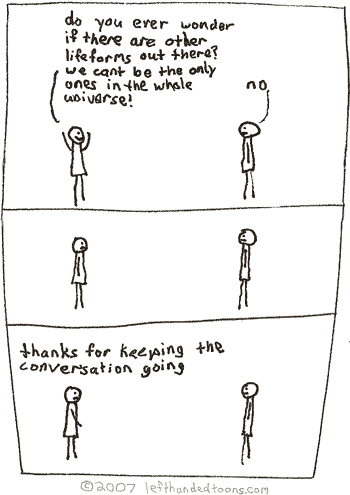 Sometimes when we are in conversation, it is helpful to ask a question which you already know the answer to. You might be thinking, this is a great idea! This gives me a chance to talk about a subject that I know about or it will give me a chance to correct people's knowledge and show others how much I really know!
Be the change by Jason Valendy is licensed under a Creative Commons Attribution-NonCommercial-ShareAlike 3.0 Unported License.