
Blindness
One of the "jobs" of any religion is to help people learn to see differently than we normally might see. This is part of the reason why the best religious teachers tend to ask questions rather than give a lot of answers (to much of the general populations' chagrin). The reason questions are used to help us all learn to see differently is because questions actually do direct our eyes. Take for instance this study done with eye-tracking software as people looked at a painting "Unexpected Guest".
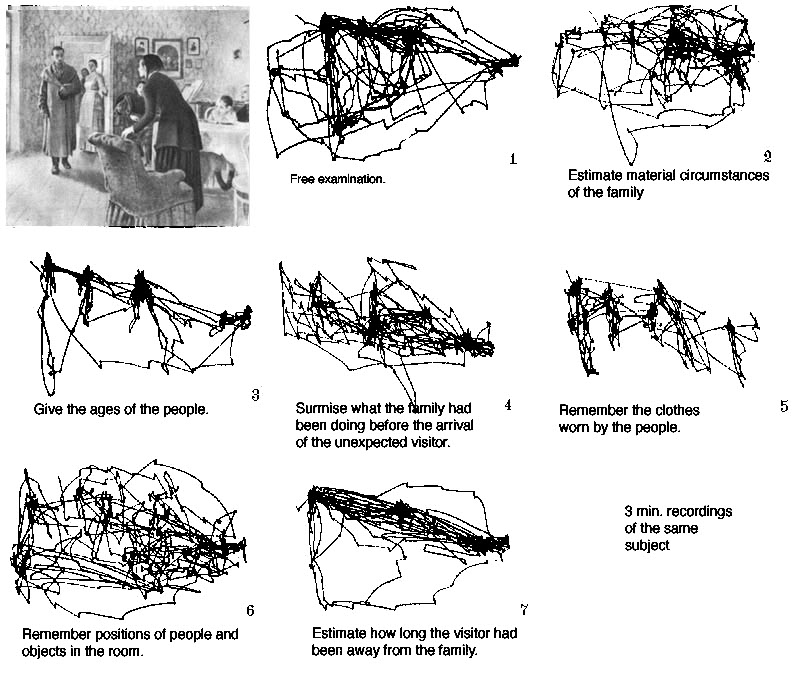
If you cannot read this picture, here is the quick explanation:
The painting is in the upper left corner and next to that people were asked to just look at the image ("Free Examination"). Their eyes were tracked and the lines you see are where and how people's eyes moved across the painting. The next images that track eye movement as a result of different questions asked. So you see the upper right tracks the eyes of people who were asked of the material wealth of the family while the lower right asks people to remember the objects in the room. You get the drift.
Notice that when there was no question asked people looked in what seems to be in something less than a pattern. However, when people were asked a question, it guided their vision toward the answer. No big deal there I suppose, but it remarkable that we seem to all "know" how to look at a painting for the answer to the question. But that is for another day.
The point of this post is that questions drive not only where we look but how we look. Thus when we approach the Bible we have to consider the questions that we bring to that reading. Because it is the questions that will direct where and how you look at that text.
It then should be no surprise that Christians consistently give the same interpretations when reading the Bible regardless of the text we are reading. It should be no surprise that the best religious teachers (in my book) are interested more in questions rather than answers. If people were told the answers to the question, say the ages of the characters in the painting, then I would be willing to bet most people would look at the painting as they do in "Free Examination"
Questions guide where AND how we look.
Answers give us permission to look only were we want to look.
To quote the book Incognito "You can know some things about the scene without knowing other aspects of it, and you become aware of what you're missing only when you're asked the question."
We can know some things about the message of Jesus without knowing other aspects of it, but we only become aware of what we are missing when we are asked the question.
So, the task of the Christian and the Christian teacher is what questions do we need to ask in order for non-Christians and nominal Christians in order to expose that which is being missed?
(In case you are counting, this post is #600 for this blog. I cannot believe how much of a spiritual discipline this is for me over the past years this has become.)
Blindness
This marks the first of several posts on blindness that I want to share. These are not my ideas, all I am doing is taking what others have done and highlighting a spiritual dimension to them.
Where we look matters in our lives. If we are looking in one direction we will miss something else. This is why slight of hand works so well. We are distracted by one thing and we miss the "trick". Where we look matters, however it is assumed that when we look we all "see" the same thing. That is when I look at an apple I assume that everyone else sees an apple. Or if I look at the color red, then I assume that others also see red. However, it is coming to light that not only where we look matters, but HOW we look matters.
These next posts are examples of how we look and most of these examples come from the book Incognito: The Secret Lives of the Brain by David Eagleman. (All quotes in this post are from this book.)
"Imagine you're watching a short film with a single actor in it. He is cooking an omelet. The camera cuts to a different angle as the actor continues his cooking. Surely you would notice if the actor changed into a different person, right? Two-thirds of observers don't."
You are kidding me right? This study shows that 2/3 of people are unable to see the actor replaced by another actor in a short film! That seems crazy. Until I saw this little video which might have been posted before.
Where we are looking matters but it also matters how we are looking, and it turns out our brains are great at allowing us to see only that which the brain thinks is important. Needless to say (and the video above articulates it well), we miss a lot of things in this world because our brain is deciding for us what is worthy of noticing.
In the next post there is an example of how questions drive what we are looking at.
Where we look matters in our lives. If we are looking in one direction we will miss something else. This is why slight of hand works so well. We are distracted by one thing and we miss the "trick". Where we look matters, however it is assumed that when we look we all "see" the same thing. That is when I look at an apple I assume that everyone else sees an apple. Or if I look at the color red, then I assume that others also see red. However, it is coming to light that not only where we look matters, but HOW we look matters.
These next posts are examples of how we look and most of these examples come from the book Incognito: The Secret Lives of the Brain by David Eagleman. (All quotes in this post are from this book.)
"Imagine you're watching a short film with a single actor in it. He is cooking an omelet. The camera cuts to a different angle as the actor continues his cooking. Surely you would notice if the actor changed into a different person, right? Two-thirds of observers don't."
You are kidding me right? This study shows that 2/3 of people are unable to see the actor replaced by another actor in a short film! That seems crazy. Until I saw this little video which might have been posted before.
Where we are looking matters but it also matters how we are looking, and it turns out our brains are great at allowing us to see only that which the brain thinks is important. Needless to say (and the video above articulates it well), we miss a lot of things in this world because our brain is deciding for us what is worthy of noticing.
In the next post there is an example of how questions drive what we are looking at.
What a Quaker, Jersey Shore, and Lord of the Rings have in common
The other day I heard a quote from a Quaker, last name Trueblood, that was shared in a sermon by Bishop Lowey on June 7th. I cannot recall the quote directly but it went something like this:
The nature of the Church is fellowship, that we can agree upon. It is the nature of that fellowship that is vital and up for discussion.
This is a great way to talk about what I have been talking about in my local setting for years now. It is not that I am not against having church so that we can have a "church family" for whom will bring us meals when we are sick or have social time with on the weekends. I am not against that sort of fellowship at all, I just wonder if that is the fellowship of the Church that we ought to be working toward?
 I hear many people talk about their church fellowship like one might think of the Brady Bunch, the Odd Couple or even the Jersey Shore. That is a group of people from different backgrounds coming together to try to live together. They have their disagreements and their good times, but ultimately they are just trying to survive and navigate life's ups and downs.
Frankly, I am not that interested in a Brady/Odd/Jersey fellowship. From my perspective, these fellowships serve a function that is very inwardly focused. That is these fellowships are interested in what makes them feel good and what makes them happy. I am not knocking this fellowship type at all, I just am not interested in it. I have areas in my life where I am self centered and seek to fulfill my own happiness as well, but I do not think the Church should be that place.

The Brady/Odd/Jersey fellowship seems to stand in contrast to the fellowship that I feel the Church is called to do and be. One might think of this form of fellowship of The Lord of the Ring. This "fellowship" had a mission and a greater purpose they all worked toward. Some were not so great at it. They were diverse (an elf AND a dwarf!) and they got along as best as they could. There are some relationships there were tighter than others (Sam and Frodo seemed close but not as close as Pip and Merry). Some died. Some lived. Some did not see each other for long stretches of time. There was happy times and not happy times, but they all moved in one accord. They had purpose and meaning greater than themselves.
And while I do not agree that the myth of redemptive violence that is found in the LotR is in line with the nature of the Church, I do believe that LotR better understands the fellowship of the Church that Trueblood was talking about.
The nature of the Church is fellowship, that we can agree upon. It is the nature of that fellowship that is vital and up for discussion.
This is a great way to talk about what I have been talking about in my local setting for years now. It is not that I am not against having church so that we can have a "church family" for whom will bring us meals when we are sick or have social time with on the weekends. I am not against that sort of fellowship at all, I just wonder if that is the fellowship of the Church that we ought to be working toward?
I hear many people talk about their church fellowship like one might think of the Brady Bunch, the Odd Couple or even the Jersey Shore. That is a group of people from different backgrounds coming together to try to live together. They have their disagreements and their good times, but ultimately they are just trying to survive and navigate life's ups and downs. Frankly, I am not that interested in a Brady/Odd/Jersey fellowship. From my perspective, these fellowships serve a function that is very inwardly focused. That is these fellowships are interested in what makes them feel good and what makes them happy. I am not knocking this fellowship type at all, I just am not interested in it. I have areas in my life where I am self centered and seek to fulfill my own happiness as well, but I do not think the Church should be that place.
The Brady/Odd/Jersey fellowship seems to stand in contrast to the fellowship that I feel the Church is called to do and be. One might think of this form of fellowship of The Lord of the Ring. This "fellowship" had a mission and a greater purpose they all worked toward. Some were not so great at it. They were diverse (an elf AND a dwarf!) and they got along as best as they could. There are some relationships there were tighter than others (Sam and Frodo seemed close but not as close as Pip and Merry). Some died. Some lived. Some did not see each other for long stretches of time. There was happy times and not happy times, but they all moved in one accord. They had purpose and meaning greater than themselves.
And while I do not agree that the myth of redemptive violence that is found in the LotR is in line with the nature of the Church, I do believe that LotR better understands the fellowship of the Church that Trueblood was talking about.

Be the change by Jason Valendy is licensed under a Creative Commons Attribution-NonCommercial-ShareAlike 3.0 Unported License.