
Selling my stock in beliefs
There was a time in my life where I really cared about beliefs. I mean to the point where I would argue until I was blue in the face and even go around looking for arguments to get into over beliefs.
After about 10 years of defending my positions and arguing, I am coming more and more to the position that beliefs, while important, are not as important as I once thought.
Beliefs seem to be intertwined with our emotions. I believe some things to be true and it is very difficult for me to be "proven" otherwise. When someone starts attacking what I believe in, I feel an instant combination of emotion and fear brought together by a sense that I have to "prove" myself. I have to prove, say the existence of a consciousness outside the individual human being (God), to someone who does not. If I am unable to do so or unable to convince the other person, then I feel like an idiot or a failure. Which allows me resort to outshout or demonize or patronize the other person who believes something else. It is all very ugly and it always ends up with me feeling more entrenched with my own views than more open to the reality that I may be incorrect.
There are studies that even argue that when we are misinformed about something and then faced with facts, we rarely change our minds.
I would argue that we are unwilling to modify our beliefs about facts because beliefs are tied to emotions and emotions are unable to understand logical arguments. Try talking logic to a child who is throwing a fit, it will not work. Ever.
 |
| Just because you believe you are tolerant does not mean you value it. Values shape behavior. |
Same for adults.
This is why I am placing less emphasis on what you believe and more emphasis on values which are revealed in lifestyle choices. We can believe things without actually acting on them. For instance, I can believe that the earth revolves around the moon and not have to change a single thing about how I live my life. However I cannot hide my values for very long at all. (see cartoon to the right)
I value my wife and son, so I am with them as much as I can be. I value the my job so I show up for work. I value living more simply so I do not eat much meat and have simple furnishings in my home. My values shape my behavior, my beliefs give me something to argue about.
Frankly I do not really care much about what others believe about who is going to heaven or who is going to hell or even if there is a heaven or a hell. Those are beliefs in my book. I am not going to loose a relationship over different beliefs. Each time Jesus attempted to sway the beliefs of the disciples, they never got it. So Jesus stopped trying to sway beliefs and attempted to sway values.
This is, in part, what I believe the Christian message has to offer the world. Not a systematic set of beliefs which we can debate back and forth. No, the message of Jesus offers us a set of values, in which we die to our own values and take on the values of Christ.
Service.
Self-sacrifice.
Love.
Forgiveness.
Grace.
Contrary to many of my fellow Christians, these are not beliefs. These are values. We do not believe in service, we do service. We do not believe in self sacrifice, we live it. We do not believe love, we show it. If we just believe in the concepts of forgiveness and grace but never share them, then we are just clashing cymbals making a lot of noise.
Who cares if you do not believe Jesus was God?
Do you value what this Jesus values?
If so, then regard less of what you might believe, you are a follower of The Way.
Rules of improv and Church
In that book Fey shares that the rules of improv dovetail nicely not only as rules for comedy but also as rules for living and leadership. I share the improv rules here as a way to encourage some thought and perhaps add a little thinking of my own.
Start with yes
Say yes, and
Make statements do not ask questions all the time
There are no mistakes, only opportunities
In the church I have encountered the violation of the first rule more often than any other rule (or commandment). When there is anything in the church, from decisions to change a ministry name to let a ministry die to unorthodox teaching, few people begin with yes. But this is not anyone's fault, it is the nature of institutions. Brian McLaren shared that institutions are there to preserve the progress made by movements. As such, institutions tend to look at new things as a potential threat to that which the institution is created to preserve. I get it. But it is not helpful to move forward in light of the numbers that point to the UMC has about 18 years left before we start loosing a great number of people (Boomers) to death. Is the church willing or even able to start with yes?
Maybe it is because I do not hear most church leaders begin with yes that I do not hear the phrase, "yes and" but that is a very uncommon statement as well. It is not unheard of, but uncommon in my experience. It drives me nuts. In a session when we are talking about ideas for a new way to connect with people in worship, any idea that is thrown out there is usually shot down if it is not thought out all the way through. It violates all the rules of brainstorming there are, but churches seem to be excel at horrible brainstorming. How can we help people brainstorm in the church, or is by nature of institutions to fear brainstorming as a potential threat to that which it was created to preserve?
Church leaders, myself included, are wonderful at asking a lot of questions, however that really can kill motivation of others to learn and participate. Fey has this example in her book,
Bad improv: Who are you? Where are we? What are we doing here? What’s in that box?
(This puts pressure on the other actor to come up with all the answers.)
Good improv: Here we are in Spain, Dracula.
Surrendering to sleep
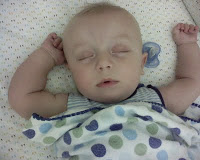
For as long as my son has been alive, most nights he easily falls asleep. These are some pictures of him when he was 3, 5 and 7 months (I think). To this day he continues to fall asleep as though he is being arrested for armed robbery.
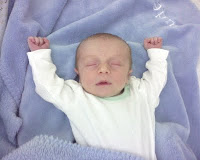
What is interesting to me is not so much the amazing beauty of my son, but rather the way in which he falls asleep. Maybe it is only my son that sleeps this way. But then I began to think and I also sleep this way. A quick little search has pictures of people who sleep this way, a facebook group and even characteristic traits tied to this position (which read like horoscopes).

I began to wonder if we could "metaphorage" this idea for a moment and note that regardless of how you sleep, we all surrender to sleep. We all at some point in time have to "give up" control and let sleep take us. We gain a number of benefits (another good article shared with me here) when we sleep but before we gain such things, we have to first surrender. We have to be willing to not be in control.
We have to be able to let go.
Religions around the world have it deep within the tradition to help people learn to let go, surrender and be aware of not being in control of all things. When we do we humans tend to have happier lives. When we are willing to let go of our schedules a little bit and engage with people on a Sunday morning, we gain the social benefits of life.
Perhaps there are those of us who are able to gain social benefits in their lives by always being in control of their schedule and always being the one who decides when you will meet with people. I have not met many people who have been successful at constantly striving for more control in life. I meet people who are more stressed and anxious about life; constantly unable to see how all the work can be done in a day.
Perhaps, just like with sleep, the way forward to fulfillment and happiness is not so much going to worship or being "religious" but setting structures in your life that force us to not be in control for a period of time.

Be the change by Jason Valendy is licensed under a Creative Commons Attribution-NonCommercial-ShareAlike 3.0 Unported License.