
Recreation
I never thought about this until it was shown to me in the book "Fall to Grace".
The book was written by the son of Jim and Tammy Fay Baker. This journey of faith is how one person discovered grace in a way that even as a preachers kid he did not know or understand.
It is a good read regardless of where you are on the theological spectrum.
In this book Baker just noted that recreation is re-creation.
No big deal, but have you ever thought about the joy you have when you participate in recreation and how it is connected to the one who creates?
Get out there and do some re-creation.

The book was written by the son of Jim and Tammy Fay Baker. This journey of faith is how one person discovered grace in a way that even as a preachers kid he did not know or understand.
It is a good read regardless of where you are on the theological spectrum.
In this book Baker just noted that recreation is re-creation.
No big deal, but have you ever thought about the joy you have when you participate in recreation and how it is connected to the one who creates?
Get out there and do some re-creation.
Freakanomoics and Church (pt 2)
Last post I tried to articulate the need to shift away from neoclassical theory of growth to new growth theory. It was rather complicated and perhaps not that great of a read. The bottom line was this: if the church wants to grow, the impetus for growth is innovation, thus the church needs to innovate ministry.
Shocking. I know.
Another little theory jumped out at me the other day while reading 30 Second Economics, it is called "Financial Instability Hypothesis". This states that stability makes people reckless with decisions. This hypothesis argues that when thing are stable in an economy then borrow in excess, lenders lend in excess and the resulting defaults on those loans lead to a financial crisis (not unlike the one we began to see in 2008).
The same can be said for church communities.
When things are good, innovation stops and people are content with the status quo. No new groups are created. Sermons become repetitive on a common theme. Leadership is locked in just keeping up with the schedule that it it difficult to see what needs to be done "down the line".
As Hyman Minsky said, "stability is unstable."
 Could this be in part why Jesus was constantly on the move? Could this be why there is a strong emphasis in the life of Jesus for the teacher to stay in touch with the Spirit through prayer? Could this be why Jesus argued that we put our heads forward and do not look back when we are plowing the field? Is this why Jesus is not interested in who sits at his right or left, because that results in status quo thinking. Could this be why the Holy Spirit pushes the disciples out of the upper room and into the streets? Could this be why Paul set up Christian communities everywhere he could.
Christians ought to be weary of stability in our churches because we can easily slip into loving the status quo.
Shocking. I know.
Another little theory jumped out at me the other day while reading 30 Second Economics, it is called "Financial Instability Hypothesis". This states that stability makes people reckless with decisions. This hypothesis argues that when thing are stable in an economy then borrow in excess, lenders lend in excess and the resulting defaults on those loans lead to a financial crisis (not unlike the one we began to see in 2008).
The same can be said for church communities.
When things are good, innovation stops and people are content with the status quo. No new groups are created. Sermons become repetitive on a common theme. Leadership is locked in just keeping up with the schedule that it it difficult to see what needs to be done "down the line".
As Hyman Minsky said, "stability is unstable."
 Could this be in part why Jesus was constantly on the move? Could this be why there is a strong emphasis in the life of Jesus for the teacher to stay in touch with the Spirit through prayer? Could this be why Jesus argued that we put our heads forward and do not look back when we are plowing the field? Is this why Jesus is not interested in who sits at his right or left, because that results in status quo thinking. Could this be why the Holy Spirit pushes the disciples out of the upper room and into the streets? Could this be why Paul set up Christian communities everywhere he could.
Christians ought to be weary of stability in our churches because we can easily slip into loving the status quo.
Freakanomoics and Church
By no means am I going to sit here and tell you that I know how to think like an economist and craft interesting arguments about real life situations using economic tools. I did however run into a little book entitled: 30 Second Economics: The 50 most thought-provoking economics theories, each explained in half a minute and it got me thinking.
There is a mindset in many of my clergy peers that I have never gotten on board with because I just do not understand it. The idea is this:
If you want a church to grow, you just need to get more people to join.
After looking at this little book for a while I believe this mantra of growth in a church (more members means more growth) is what is called a Neoclassical growth theory. Not to get too heady here but this theory states that there are three things that drive growth which I parenthetically translate in "church-speak" - capital (money), labor (people), technology (ministries).
This theory states that if you have money and labor that adapts to technological changes then you have growth. And it works, but the main driver of growth is technology (ministries). We can build all the church buildings we want to, but eventually the "market" for church buildings will run dry and only until there is a technological change in the way church "is done" that growth happens.
We can see this in the mega church movement. These communities changed the way the did ministries and that leads to a whole new growth. It was the same of the "emergent church" and the "neo-monastic" movements. New ways of doing ministry lead to growth.
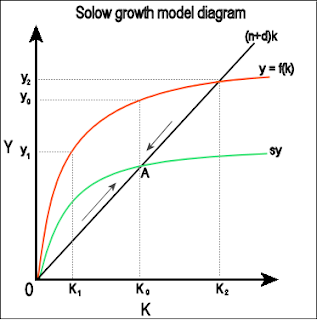 The problem that I see is that many of those who feel the way to grow a church is to get more members are correct to a point. As you can see in the image to the right, growth in the neoclassical theory has diminishing returns over time and rises quickly then slowly grows (see the red line).
The real way to drive growth is through technology, or a better word would be innovation.
For ages we have waited for different innovative technologies/ministries to come into existence and then the church co-opts them. Take the whole "Christian music" industry. It is just "regular music" but with Jesus lyrics. We co-oped it.
But the Christian music "innovation" was something that came from outside the church and the church took it on. This innovative way to connect with people was something that the church did not think of but uses often in worship. The church waits for innovate technologies/ministries to crop up and then we co-op them.
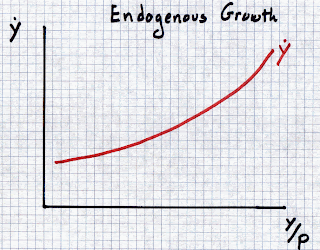
If innovation drives growth (as per the Neoclassical growth model argues) then the church must stop focusing on people and money and focus on innovation. When we do then growth patterns look differently (see this red line that maps out endogenous or New growth theory)
Apple could stop making new Ipads and soon enough their growth will stop, because everyone has one.
Google could stop creating things like "docs" and soon enough their growth will stop, because we have many ways to share files.
Facebook could stop creating new ways to connect people and soon enough their growth will stop, because there are many looking to be like FB.
Innovation is the key to growth, even (especially) growth in a church. Look at the innovation in the message of Jesus and Paul!
I am calling on all church leaders to being to shift the way we look at growth and stop focusing on just "getting more people". Rather, we need to adopt "New Growth Theory" and innovate from within. This means we need to stop waiting for innovation to happen then the church co-ops it.
The church needs to innovate. Look at the history of the church, when it innovated the numbers grew:
Jesus - church is born
Paul - churches are planted
Constantine - "everyone" becomes Christian
Desert Abbas/Ammas - rise of monasteries and mass education
Luther - "priesthood of all believers" empowers people to read the Bible
Wesley - bands and classes lead to a revival of faith across the US and England
There is a mindset in many of my clergy peers that I have never gotten on board with because I just do not understand it. The idea is this:
If you want a church to grow, you just need to get more people to join.
After looking at this little book for a while I believe this mantra of growth in a church (more members means more growth) is what is called a Neoclassical growth theory. Not to get too heady here but this theory states that there are three things that drive growth which I parenthetically translate in "church-speak" - capital (money), labor (people), technology (ministries).
This theory states that if you have money and labor that adapts to technological changes then you have growth. And it works, but the main driver of growth is technology (ministries). We can build all the church buildings we want to, but eventually the "market" for church buildings will run dry and only until there is a technological change in the way church "is done" that growth happens.
We can see this in the mega church movement. These communities changed the way the did ministries and that leads to a whole new growth. It was the same of the "emergent church" and the "neo-monastic" movements. New ways of doing ministry lead to growth.
 The problem that I see is that many of those who feel the way to grow a church is to get more members are correct to a point. As you can see in the image to the right, growth in the neoclassical theory has diminishing returns over time and rises quickly then slowly grows (see the red line).
The real way to drive growth is through technology, or a better word would be innovation.
For ages we have waited for different innovative technologies/ministries to come into existence and then the church co-opts them. Take the whole "Christian music" industry. It is just "regular music" but with Jesus lyrics. We co-oped it.
But the Christian music "innovation" was something that came from outside the church and the church took it on. This innovative way to connect with people was something that the church did not think of but uses often in worship. The church waits for innovate technologies/ministries to crop up and then we co-op them.
If innovation drives growth (as per the Neoclassical growth model argues) then the church must stop focusing on people and money and focus on innovation. When we do then growth patterns look differently (see this red line that maps out endogenous or New growth theory)

Apple could stop making new Ipads and soon enough their growth will stop, because everyone has one.
Google could stop creating things like "docs" and soon enough their growth will stop, because we have many ways to share files.
Facebook could stop creating new ways to connect people and soon enough their growth will stop, because there are many looking to be like FB.
Innovation is the key to growth, even (especially) growth in a church. Look at the innovation in the message of Jesus and Paul!
I am calling on all church leaders to being to shift the way we look at growth and stop focusing on just "getting more people". Rather, we need to adopt "New Growth Theory" and innovate from within. This means we need to stop waiting for innovation to happen then the church co-ops it.
The church needs to innovate. Look at the history of the church, when it innovated the numbers grew:
Jesus - church is born
Paul - churches are planted
Constantine - "everyone" becomes Christian
Desert Abbas/Ammas - rise of monasteries and mass education
Luther - "priesthood of all believers" empowers people to read the Bible
Wesley - bands and classes lead to a revival of faith across the US and England

Be the change by Jason Valendy is licensed under a Creative Commons Attribution-NonCommercial-ShareAlike 3.0 Unported License.